The Family and Health Workers Support Role to Undergo Triple Elimination Screening in Pregnant Women based on The Health Belief Model Perspevtive
DOI:
https://doi.org/10.26699/jnk..v13i2.ART.p232-240Keywords:
Health Belief Model, Family Support, Pregnant Mother, Health Workers, Triple EliminationAbstract
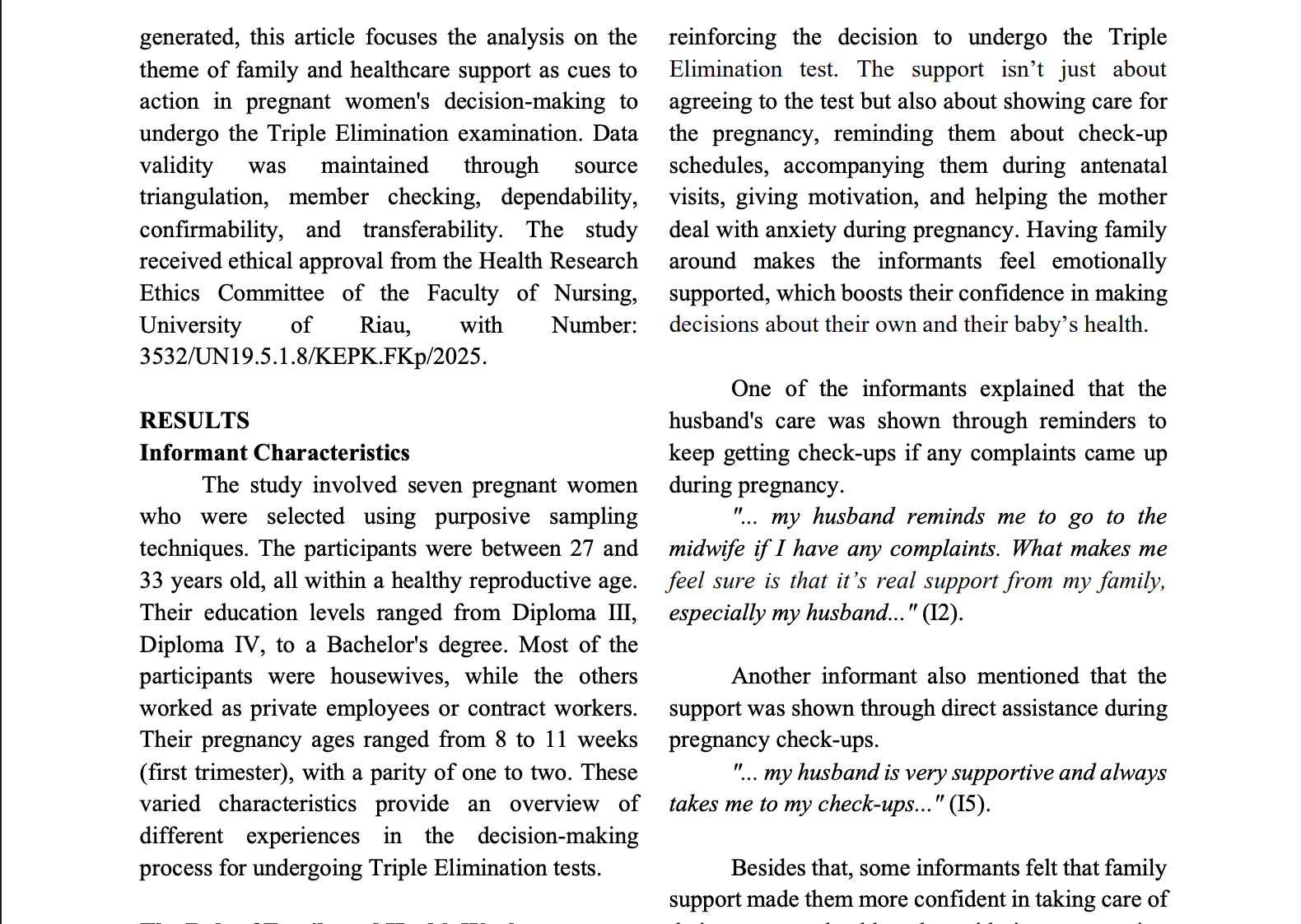
Triple Elimination testing is an important strategy to prevent the transmission of HIV, syphilis, and hepatitis B from mother to child. However, currently the coverage of check-ups for pregnant women is still not optimal. This study aimed to explore the role of family and health worker’s support in strengthening pregnant women's decisions to undergo Triple Elimination tests based on Health Belief Model perspective. This study used a qualitative design with a descriptive approach. Seven pregnant mothers were selected using purposive sampling in the working area of Sidomulyo Health Center, Pekanbaru City. Data were collected through in-depth interviews using semi-structured guidelines and manually analysed using the Directed Content Analysis method. The analysis produced one main theme, which is the role of family and healthcare support as reinforcing factors in pregnant women's decision-making, consisting of two subthemes: family support as a decision booster and healthcare support as a booster of pregnant women's confidence. Family support comes in the form of attention, motivation, accompaniment, and emotional reinforcement, while healthcare providers offer education, counselling, and therapeutic communication that increase confidence and reduce doubts regarding Triple Elimination checks. Family and healthcare support are important factors that reinforce a pregnant woman's decision to undergo Triple Elimination check-ups by boosting confidence, a sense of security, and understanding of the benefits of early detection. Antenatal services need to optimize family involvement, especially the husband, and enhance education and therapeutic communication by healthcare workers to increase pregnant women's participation in Triple Elimination check-ups
References
Alyafei, A., & Easton-Carr, R. (2024). The health belief model of behavior change. https://www.ncbi.nlm.nih.gov/books/nbk606120/.
Armini, L. N., Setiawati, E. P., Arisanti, N., & Hilmanto, D. (2024). Patient perspective on the elimination mother-to-child transmission of HIV, syphilis, and hepatitis B in Bali, Indonesia: a qualitative study. BMC Public Health, 24(1), 2258. https://doi.org/10.1186/s12889-024-19692-3
Dehbozorgi, R., Moghadam, M., Shahriari, M., & Sarani, E. (2022). Barriers to family involvement in the care of patients with chronic mental illnesses: A qualitative study. Front Psychiatry, 1-11.
Dinkes Kota Pekanbaru. (2024). Laporan Kinerja Instansi Pemerintah. Dinkes Pekanbaru.
Dinkes Provinsi Riau. (2023). Laporan Kinerja Instansi pemerintah (LKJIP) Tahun 2022. Dinas kesehatan Provinsi Riau.
Elgalib, A., Lau, R., Al-Habsi, Z., Shah, S., Al-Rawahi, B., Memish, Z. A., Lee, S. S., & Al-Abri, S. (2023). Elimination of mother-to-child transmission of HIV, syphilis and viral hepatitis B: A call for renewed global focus. International Journal of Infectious Diseases, 127, 33–35. https://doi.org/10.1016/j.ijid.2022.11.031
Haning, F. L. A., Lada, C. O., Junias, M. S., Manafe, Y. J., & Gero, S. (2022). Aspek Health Belief Model dan Kepatuhan Ibu Melakukan Kunjungan Antenatal K4 di Masa Pandemi COVID-19. Journal of Telenursing (JOTING), 4(2), 804–819. https://doi.org/10.31539/joting.v4i2.3898
Kemenkes RI. (2024). Profil Kesehatan Indonesia. Kementerian Kesehatan Republik Indonesia.
Kurniawan, D., Sahar, J., Rekawati, E., & Sartika, R. (2025). Translation and validation of the Indonesian version of the Family Support Scale (FSS) for elderly. Lentera Perawat, 713-721.
Dehbozorgi, R., Moghadam, M., Shahriari, M., & Sarani, E. (2022). Barriers to family involvement in the care of patients with chronic mental illnesses: A qualitative study. Front Psychiatry, 1-11.
Lian, J., Ke, B., Zhang, X., Li, J., Li, Y., Wang, K., Feng, Y., & Wang, S. (2025). Global burden of HIV, syphilis, and HBV infection among women of childbearing age and children under five: based on the Global Burden of Diseases Study 2021. Frontiers in Public Health, 13. https://doi.org/10.3389/fpubh.2025.1666408
Mumtaz, Z. (2023). Factors Influencing the Uptake of HIV Testing During Antenatal Care in Rural Uganda. Journal of Women’s Health Care, 02(02). https://doi.org/10.4172/2167-0420.1000121
Purwantanti, T. C., Demartoto, A., & Murti, B. (2024). Multilevel Analysis of The Implementation of The Health Belief Model on Antenatal Visit at Integrated Health Posts in Kapuas Hulu, West Kalimantan, Indonesia. Journal of Health Promotion and Behavior, 9(3), 236–244. https://doi.org/10.26911/thejhpb.2024.09.03.05
Sabin, L., Haghparast-Bidgoli, H., Thapaliya, B., Chand, O., Bhattarai, S., Arjyal, A., & Saville, N. (2024). Factors influencing the implementation of integrated screening for HIV, syphilis, and hepatitis B for pregnant women in Nepal: A qualitative study. PLOS Global Public Health, 4(10), e0003006. ˚https://doi.org/10.1371/journal.pgph.0003006
Shivambo, L., Ntsie, L., Qwabi, T., Shaik, S., Maixenchs, M., Johnstone, S., Blevins, J., Dangor, Z., Madhi, S., & Myburgh, N. (2025). Understanding Barriers to HIV testing Among Pregnant women in Soweto, Johannesburg: A Socio-Ecological Perspective. https://doi.org/10.12688/verixiv.2029.1
Siahaan, V. R., & Sembiring, R. N. (2026). The effect of health education on pregnant women’s knowledge and attitudes regarding triple elimination. . Jurnal Kebidanan Malahayati, 12(4), 233–239.
Syaputri, R., Hartono, B., & Rawani, A. (2024). Evaluating the Triple Elimination Screening Program for Pregnant Women in Rokan Hilir District, Indonesia. Viva Medika: Jurnal Kesehatan, Kebidanan, Dan Keperawatan, 17(1), 73–87.
Varela, N., Dewi, Y., Murti, B., Novika, R., & Rahardjo, S. (2026). The Role of the Health Belief Model in Antenatal Care Visits among Pregnant Women at Sentru Saude Komunitaria, Baucau Municipality, Timor Leste. Journal of Health Promotion and Behavior, 11(1), 41–54.
Vebriyani, N., Putri, R., & Munawaroh, M. (2022). Hubungan Persepsi, Sumber Informasi dan Perilaku Ibu Hamil terhadap Pemeriksaan Triple Eliminasi. Journal of Midwifery Science and Women’s Health, 2(2), 52–59. https://doi.org/10.36082/jmswh.v2i2.542
WHO, & United Nations Children’s Fund. (2025). Country guidance for planning triple elimination of mother-to-child transmission of HIV, syphilis and hepatitis B virus programmes. Https://Iris.Who.Int/.
Wiantini, N. N., Widiastini, L. P., & Risna, N. M. (2023). The Effect of Triple Elimination Health Education to Knowledge and Intention Level of Pregnant Women in Screening Triple Elimination Implementation. Jurnal Kesehatan Pasak Bumi Kalimantan, 5(1), 17. https://doi.org/10.30872/j.kes.pasmi.kal.v5i1.7327
Wulandari, A., Suryani, P., Siwi, R., & Retnaningtyas, E. (2025). Compliance in Carrying Out Triple Elimination Examination Reviewed from Parity and Husband Support in Pregnant Women at Gondanglegi Public Health Center, Malang Regency. Journal Of Nursing Practice, 8(4), 884–895. https://doi.org/10.30994/jnp.v8i4.870
Downloads
Published
Issue
Section
License
Copyright (c) 2026 Jurnal Ners dan Kebidanan (Journal of Ners and Midwifery)

This work is licensed under a Creative Commons Attribution-ShareAlike 4.0 International License.