Nurse-Physician Collaboration in Mitigating Workload-Induced Burnout and Turnover Intention: A Scoping Review of Adaptive Risk Pathways
DOI:
https://doi.org/10.26699/jnk..v13i2.ART.p218-231Keywords:
Workload, Turnover Intention, Nurse–Physician Collaboration, Hospital, Interprofessional TeamworkAbstract
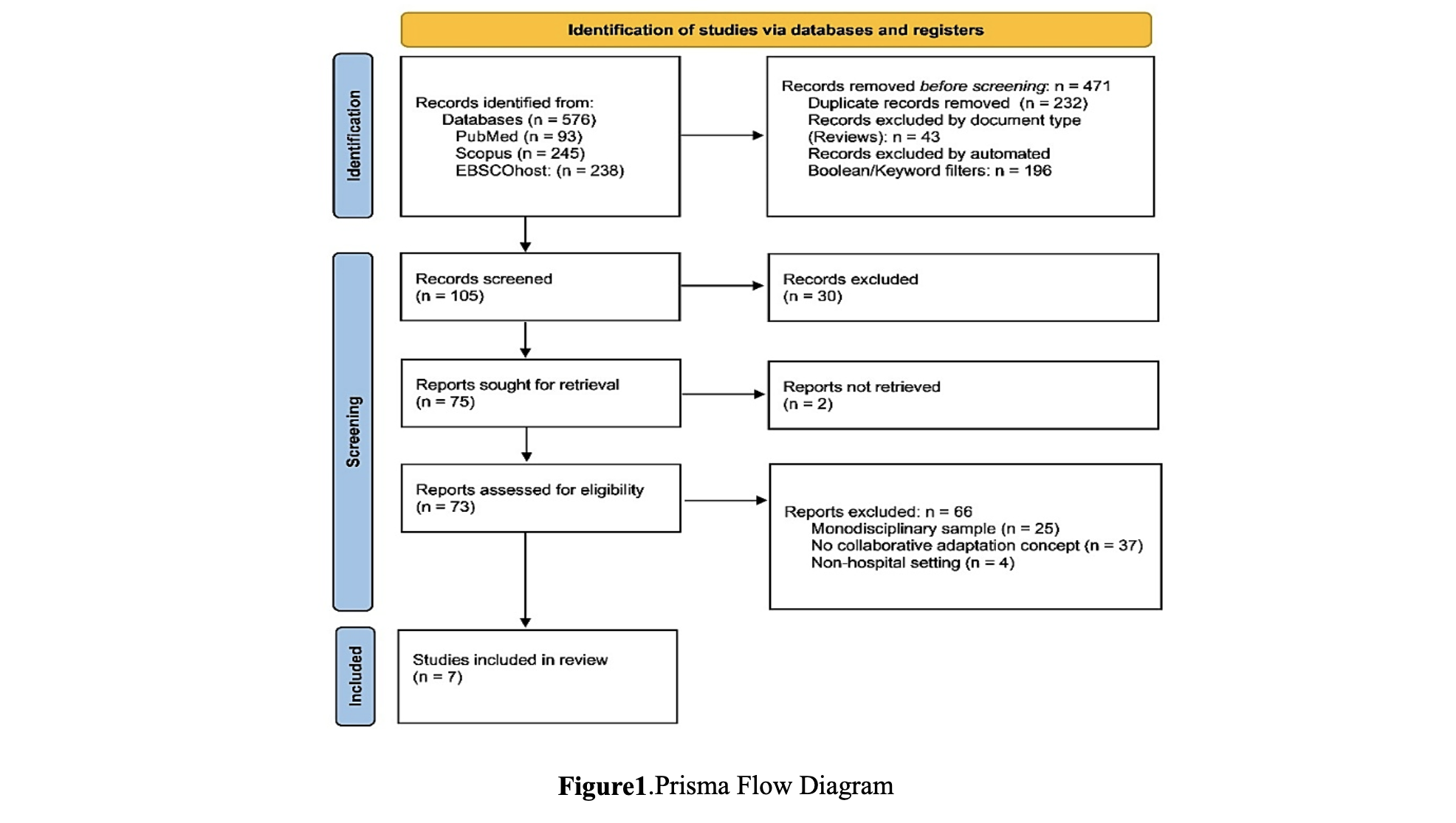
Burnout and turnover intention threaten hospital workforce stability and patient safety. Workload is an established contributor, but how nurse–physician collaboration may interrupt this pathway across hospital contexts remains unclear. This scoping review followed Joanna Briggs Institute methodology, the Population–Concept–Context framework, and PRISMA-ScR guidance. PubMed, Scopus, and EBSCOhost were searched from database inception to 19 May 2026, with eligibility restricted to English-language peer-reviewed empirical studies published in 2022–2026. Of 576 records identified, seven studies were included after screening. The data were charted and interpreted using the Roy Adaptation Model. The seven studies (N = 51,711) identified staffing shortages, high patient acuity, time pressure, administrative and electronic health record burden, and crisis-related disruption. Collaboration involved relational coordination, shared goals, mutual respect, shared decision-making, mentorship, and peer support. Supportive collaboration was associated with job satisfaction, well-being, and intention to stay, whereas weak or unsupported collaboration coincided with burnout, moral injury, fatigue, and turnover intention. Collaboration may reduce uncertainty, distribute clinical responsibility, and strengthen collective coping; however, its protective value depends on staffing adequacy, responsive leadership, and work-system support. Nurse–physician collaboration may mitigate adverse workforce outcomes but cannot substitute for safe staffing and organizational support. Hospitals should integrate workload reduction with structured interprofessional communication, shared governance, mentoring, and peer support. Longitudinal and intervention studies are needed to test mediation and moderation effects.
References
Aiken, L. H., Lasater, K. B., Sloane, D. M., Pogue, C. A., Fitzpatrick Rosenbaum, K. E., Muir, K. J., & McHugh, M. D. (2023). Physician and Nurse Well-Being and Preferred Interventions to Address Burnout in Hospital Practice: Factors Associated With Turnover, Outcomes, and Patient Safety. JAMA Health Forum, 4(7), E231809. https://doi.org/10.1001/jamahealthforum.2023.1809
Aiken, L. H., Sermeus, W., McKee, M., Busse, R., Smith, H., Maier, C. B., Drennan, J., Dello, S., Kohnen, D., McHugh, M. D., & Lasater, K. B. (2025). Informing Hospital Physician Well-Being Interventions in Europe and the US. JAMA Network Open, 8(11), e2544067-null. https://doi.org/10.1001/jamanetworkopen.2025.44067
Aiken, L. H., Sermeus, W., McKee, M., Lasater, K. B., Sloane, D., Pogue, C. A., Kohnen, D., Dello, S., Bettina Maier, C. B., Drennan, J., & McHugh, M. D. (2024). Physician and nurse well-being, patient safety and recommendations for interventions: cross-sectional survey in hospitals in six European countries. BMJ Open, 14(2), e079931. https://doi.org/10.1136/bmjopen-2023-079931
Al Sabei, S., AbuAlRub, R., Al Yahyaei, A., Al-Rawajfah, O. M., Labrague, L. J., Burney, I. A., & Al-Maqbali, M. (2023). The influence of nurse managers’ authentic leadership style and work environment characteristics on job burnout among emergency nurses. International Emergency Nursing, 70. https://doi.org/10.1016/j.ienj.2023.101321
Al Sabei, S. D., Labrague, L. J., Al‐Rawajfah, O., AbuAlRub, R., Burney, I. A., & Jayapal, S. K. (2022). Relationship between interprofessional teamwork and nurses’ intent to leave work: The mediating role of job satisfaction and burnout. Nursing Forum, 57(4), 568–576.
Al-Bustanji, M. F., Rayan, A., Eshah, N. F., Masa’deh, R., Baqeas, M. H., Rayyan, N., Rayyan, D., & ALBashtawy, M. (2024). Nurses’ Perceptions of Nurse–Physician Collaboration and Quality of Care in Public Hospitals. SAGE Open Nursing, 10, 23779608241286770. https://doi.org/10.1177/23779608241286767
Al-Dajani, M. A., Alrishan, M., Ali Alzaher, D., Mubarak Almotairi, O., Mobarak Almotairy, M., Erfan Al Qasemi, O. M., Mobarak Almotairy, A., Mohammad Kharabah, R., Muslim Alloqmani, S., Mohammad Fadail, Z., Jamalaldeen Alkhateeb, O., Jamaluddin Alkhateeb, M., Abdulrahim Abdulrahman Jan, M., Ahmad Amara, K., & Ghazi Faraj, nada. (2023). Impact of Physician Workload on Clinical Performance: A Comprehensive Review of Factors, Challenges, and Solutions. 22(1).
Arnoux-Nicolas, C., Sovet, L., Lhotellier, L., Di Fabio, A., & Bernaud, J. L. (2016). Perceived work conditions and turnover intentions: The mediating role of meaning of work. Frontiers in Psychology, 7(MAY), 179726. https://doi.org/10.3389/FPSYG.2016.00704/TEXT
Bae, S.-H. (2024). Assessing the impacts of nurse staffing and work schedules on nurse turnover: A systematic review. International Nursing Review, 71(1), 168 – 179. https://doi.org/10.1111/inr.12849
Bakhoum, N., Gerhart, C., Schremp, E., Jeffrey, A. D., Anders, S., France, D., & Ward, M. J. (2021). A Time and Motion Analysis of Nursing Workload and Electronic Health Record Use in the Emergency Department. Journal of Emergency Nursing, 47(5), 733. https://doi.org/10.1016/J.JEN.2021.03.007
Boskma, A., van der Braak, K., Hooft, L., Oerbekke, M., Franx, A., & van der Laan, M. (2025). Effectiveness of organization-directed interventions on healthcare professionals’ well-being: a systematic review. EClinicalMedicine, 88. https://doi.org/10.1016/j.eclinm.2025.103496
Dahlawi, H. H., Al obaidellah, M. M., Rashid, N. A., Alotaibi, A. A., Al-Mussaed, E. M., Cheung, M. M. M., Abuaish, S., & Cordero, M. A. W. (2023). Defining Physician–Nurse Efforts toward Collaboration as Perceived by Medical Students. Healthcare, 11(13), 1919. https://doi.org/10.3390/HEALTHCARE11131919
Degu, T., Amsalu, E., Kebede, A., & Adal, O. (2023). Inter-professional collaboration and associated factors among nurses and physicians in specialized public hospitals, the northwest, Ethiopia: mixed method multi-centered cross-sectional study. BMC Health Services Research, 23(1). https://doi.org/10.1186/s12913-023-09200-5
D’Silva, R., Balakrishnan, J. M., Bari, T., Verma, R., Kamath, R., D’Silva, R., Balakrishnan, J. M., Bari, T., Verma, R., & Kamath, R. (2024). Unveiling the Heartbeat of Healing: Exploring Organizational Culture in a Tertiary Hospital’s Emergency Medicine Department and Its Influence on Employee Behavior and Well-Being. International Journal of Environmental Research and Public Health, 21(7), null-null. https://doi.org/10.3390/ijerph21070912
Elhouda Mohamed Awad, N., Mahmoud Hassan, R., & Abdelazeem Mostafa, H. (2024). Nurse-Physician Collaboration as Perceived by Nurses and its ’ Relation to Professional Autonomy and Team Commitment. In Original Article Egyptian Journal of Health Care (Vol. 15, Number 4).
Falatah, R. (2017). RELATIONAL COORDINATION: A PREDICTOR OF NURSE JOB SATISFACTION, ORGANIZATIONAL COMMITMENT, AND TURNOVER INTENTION. https://doi.org/10.7275/10693829.0
Febrianti, V., Pitono, A. J., Arifin, A., & Yudha, E. K. (2024). The Workload and Stress Levels Among Staff Nurses in the Inpatient Ward of a Secondary Health Care Service in Indonesia. Fundamental and Management Nursing Journal, 7(2), 74–83. https://doi.org/10.20473/FMNJ.V7I2.49397
Gesner, E., Dykes, P. C., Zhang, L., & Gazarian, P. (2022). Documentation Burden in Nursing and Its Role in Clinician Burnout Syndrome. Applied Clinical Informatics, 13(5), 983 – 990. https://doi.org/10.1055/s-0042-1757157
Gittell, J. H., Logan, C., Cronenwett, J., Foster, T. C., Freeman, R., Godfrey, M., & Vidal, D. C. (2018). Impact of relational coordination on staff and patient outcomes in outpatient surgical clinics. https://doi.org/10.1097/HMR.0000000000000192
Guessoum, S. B., Marvaldi, M., Thomas, I., Lachal, J., Carretier, E., Moro, M. R., & Benoit, L. (2022). The experience of anaesthesiology care providers in temporary intensive care units during the COVID-19 pandemic in France: a qualitative study. Anaesthesia Critical Care and Pain Medicine, 41(3). https://doi.org/10.1016/j.accpm.2022.101061
House, S., Crandell, J., Stucky, C., Kitzmiller, R., Jones, C., & Gittell, J. H. (2023). Relational Coordination as a Predictor of Job Satisfaction and Intent to Stay Among Nurses and Physicians in the Military Health System. Military Medicine, 188(1–2), e316–e325. https://doi.org/10.1093/milmed/usab464
Kwon, E. O., Ha, M., Hee, S., & Sun, H. (2019). Effects of Nurse-Physician Collaboration on Nursing Performance and Organizational Commitment in Intensive Care Unit Nurses. Journal of Korean Academy of Nursing Administration, 25(3), 186–197. https://doi.org/10.11111/JKANA.2019.25.3.186
Lee, H. E., Cho, S. S., & Kang, M. Y. (2026). Association of work-time control with burnout and turnover intention: a cross-sectional analysis of a general working population in Korea. Epidemiology and Health, 48, e2026011. https://doi.org/10.4178/EPIH.E2026011
Liu, Y., Duan, Y., & Guo, M. (2023). Turnover intention and its associated factors among nurses: a multi-center cross-sectional study. Frontiers in Public Health, 11, 1141441. https://doi.org/10.3389/FPUBH.2023.1141441/TEXT
Longo, B. A., Schmaltz, S. P., Williams, S. C., Shanafelt, T. D., Sinsky, C. A., & Baker, D. W. (2023). Clinician Well-Being Assessment and Interventions in Joint Commission–Accredited Hospitals and Federally Qualified Health Centers. Joint Commission Journal on Quality and Patient Safety, 49(10), 511 – 520. https://doi.org/10.1016/j.jcjq.2023.04.007
Low, S., Gray, E., Ewing, A., Hain, P., & Kim, L. (2021). Remodeling interprofessional collaboration through a nurse-for-a-day shadowing program for medical residents. Journal of Multidisciplinary Healthcare, 14, 2345 – 2349. https://doi.org/10.2147/JMDH.S319728
Miri, F., Hajizadeh, A., Arefnezhad, M., Alipour, R., Saeidpour, J., Roh, Y. S., & Kakemam, E. (2026). The Association Between Nurses’ Perceptions of Teamwork and Nurse and Patient Outcomes in Hospital Settings: A Systematic Review. Journal of Nursing Management, 2026(1), 3356709. https://doi.org/10.1155/JONM/3356709
Moisoglou, I., Katsiroumpa, A., Fradelos, E. C., Papathanasiou, I. V., Paralikas, T., Prasini, I., Rekleiti, M., Katsapi, A., Chatzi, M., & Galanis, P. (2025). Association between nursing work environment, burnout, and turnover intention: A cross-sectional study in Greece. AIMS Public Health, 12(4), 1069–1083. https://doi.org/10.3934/PUBLICHEALTH.2025054
Moy, A. J., Schwartz, J. M., Chen, R., Sadri, S., Lucas, E., Cato, K. D., & Rossetti, S. C. (2021). Measurement of clinical documentation burden among physicians and nurses using electronic health records: a scoping review. Journal of the American Medical Informatics Association : JAMIA, 28(5), 998–1008. https://doi.org/10.1093/jamia/ocaa325
Park, S., Yoo, J., Lee, Y., DeGuzman, P. B., Kang, M. J., Dykes, P. C., Shin, S. Y., & Cha, W. C. (2024). Quantifying emergency department nursing workload at the task level using NASA-TLX: An exploratory descriptive study. International Emergency Nursing, 74. https://doi.org/10.1016/J.IENJ.2024.101424
Roy, C., Whetsell, M. V., & Frederickson, K. (2009). The Roy adaptation model and research: Global perspective. Nursing Science Quarterly, 22(3), 209–211. https://doi.org/10.1177/0894318409338692
Safitri, D., & Hartartiyanto, G. (2024). Unveiling the Impact of Psychological Contract Breach: The Moderating Role of Mindfulness in Job Performance, Burnout, and Turnover Intention. Economic Insights – Trends and Challenges, 2024(4), 1–10. https://doi.org/10.51865/eitc.2024.04.01
Sarmadi, S., Sanaie, N., Pour, M. B., & Zare-Kaseb, A. (2025). Nurse–physician collaboration, autonomy, and decision-making ability among intensive care unit nurses in Tehran, Iran: A cross-sectional study. PLOS One, 20(12), e0336430. https://doi.org/10.1371/JOURNAL.PONE.0336430
Schwabe, K., Ferizaj, D., Neumann, S., Strube-Lahmann, S., & Lahmann, N. (2025). Time Savings Through an AI Speech Assistant for Nursing Documentation: A Pre–Post Time-Motion Study in German Long-Term Care (Preprint). https://doi.org/10.2196/PREPRINTS.86078
Siabi, A., Lamiri, A., & Agoub, M. (2025). Relationship between Health Professional Involvement, Organizational Factors, and Professional Outcomes. The Open Nursing Journal, 19(1). https://doi.org/10.2174/0118744346436864251014041325
Snyder, R. L., White, K. A., Anderson, L. E., & Cochran, R. L. (2025). Exploring burnout and staff turnover among acute care nurses and physicians during the COVID-19 pandemic: Insights from a qualitative assessment. Plos One, 20(6 June), e0319390. https://doi.org/10.1371/journal.pone.0319390
Tricco, A. C., Lillie, E., Zarin, W., O’Brien, K. K., Colquhoun, H., Levac, D., Moher, D., Peters, M. D. J., Horsley, T., Weeks, L., Hempel, S., Akl, E. A., Chang, C., McGowan, J., Stewart, L., Hartling, L., Aldcroft, A., Wilson, M. G., Garritty, C., … Straus, S. E. (2018). PRISMA Extension for Scoping Reviews (PRISMA-ScR): Checklist and Explanation. Annals of Internal Medicine, 169(7), 467–473. https://doi.org/10.7326/M18-0850
Wiedermann, C. J., Barbieri, V., Engl, A., & Piccoliori, G. (2024). Impact of Relational Coordination on Job Satisfaction and Willingness to Stay: A Cross-Sectional Survey of Healthcare Professionals in South Tyrol, Italy. Behavioral Sciences 2024, Vol. 14, Page 397, 14(5), 397. https://doi.org/10.3390/BS14050397
Yılmaz, G., Kıran, Ş., & Bulut, H. K. (2023a). The mediating role of nurse-physician collaboration in the effect of organizational commitment on turnover intention. Journal of Interprofessional Care, 37(1), 66–72. https://doi.org/10.1080/13561820.2021.2004099
Yılmaz, G., Kıran, Ş., & Bulut, H. K. (2023b). The mediating role of nurse–physician collaboration in the effect of organizational commitment on turnover intention. Journal of Interprofessional Care, 37(1), 66 – 72. https://doi.org/10.1080/13561820.2021.2004099
Downloads
Published
Issue
Section
License
Copyright (c) 2026 Jurnal Ners dan Kebidanan (Journal of Ners and Midwifery)

This work is licensed under a Creative Commons Attribution-ShareAlike 4.0 International License.