Emotional Intelligence as a Predictor of Clinical Decision-Making Ability among Nursing Students in Aceh, Indonesia
DOI:
https://doi.org/10.26699/jnk..v13i2.ART.p192-204Keywords:
Clinical Decision Making, Emotional Intelligence, Nursing Education, Nursing StudentsAbstract
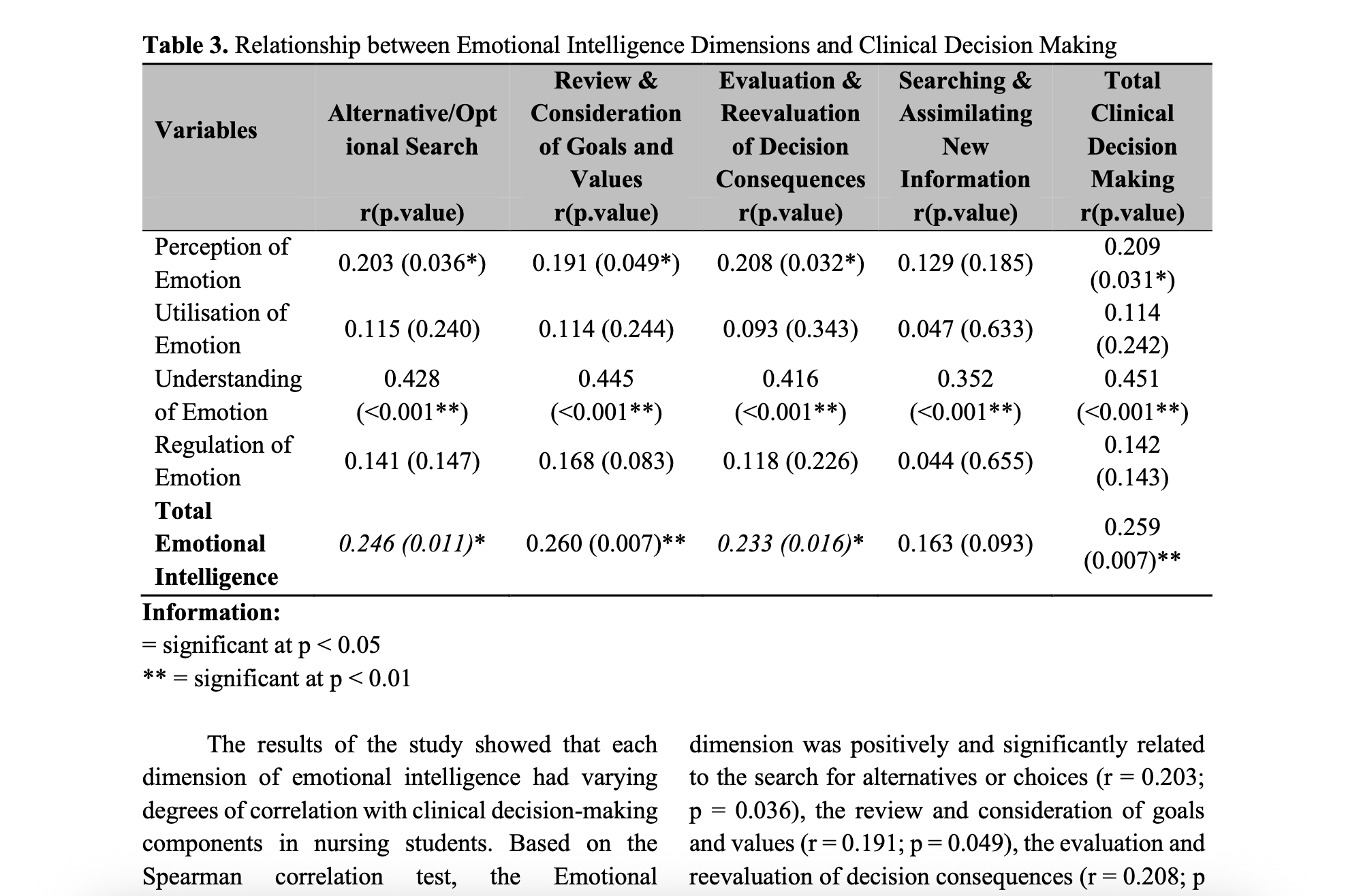
In nursing practice, clinical decision-making is a critical competency that students must possess to ensure patient safety and the quality of nursing care. This process is influenced not only by cognitive abilities but also by emotional intelligence, which helps students remain objective when facing complex and high-pressure clinical situations. Although various studies have examined the relationship between the two, the results obtained remain inconsistent. Therefore, this study aims to analyze the relationship between emotional intelligence and clinical decision-making among students in the Professional Nursing Program using a descriptive correlational design and a cross-sectional approach. A total of 107 students from three nursing education institutions in Banda Aceh were selected as participants using consecutive sampling. Emotional intelligence was measured using the Schutte Self-Report Emotional Intelligence Test, while clinical decision-making ability was measured using the Clinical Decision-Making in Nursing Scale. Data analysis was performed using Spearman’s correlation test. The results of the study indicate a positive and significant relationship between emotional intelligence and clinical decision-making (r=0.259; p= 0.007). Among all dimensions of emotional intelligence, Understanding of Emotion showed the strongest and most significant relationship with all components of clinical decision-making (p = 0.001), whereas the dimensions of Utilisation of Emotion and Regulation of Emotion did not show a significant relationship. Emotional intelligence plays a role in supporting clinical decision-making abilities among students in the Professional Nursing Program. Therefore, the development of emotional intelligence needs to be integrated into nursing education to support the improvement of students’ clinical decision-making abilities.
References
Aghabarary, M., & Khedmatizare, M. (2025). Emotional intelligence as a predictor of clinical competence in nursing students. BMC Research Notes, 18(1), 25. https://doi.org/10.1186/s13104-025-07106-5
AL Btoush, M. R., Malak, M. Z., Hamaideh, S. H., & Shuhaiber, A. H. (2025). The relationship between emotional intelligence, self-efficacy, and clinical decision-making among critical care nurses in Jordan. Journal of Human Behaviour in the Social Environment, 35(3), 454–468. https://doi.org/10.1080/10911359.2024.2310261
Ali, A. Z. F., & Nageeb, S. M. (2020). Effect of Problem-Solving Educational Program on Decision-Making Skills among Nurses in Critical Care Units. 7(1), 148–160.
Alsufyani, A. M., Almalki, M. S., Khader, K. A., Stanford, P., Freeman, S., & Alsufyani, Y. M. (2024). The Impact of Perceived Emotional Intelligence on Occupational Stress Among Nurses: Empirical Evidence from a Saudi Health Cluster. Journal of Nursing Management, 2024, 8876168. https://doi.org/10.1155/2024/8876168
Ayed, A. (2025). The Relationship Between Emotional Intelligence and Clinical Decision-Making Among Nurses in Neonatal Intensive Care Units. Sage Open Nursing, 11, 23779608251321350. https://doi.org/10.1177/23779608251321352
Beauvais, A., Andreychik, M., & Henkel, L. A. (2017). The role of emotional intelligence and empathy in compassionate nursing care. Mindfulness & Compassion, 2(2), 92–100. https://doi.org/10.1016/j.mincom.2017.09.001
Benner, P. (2015). Curricular and pedagogical implications for the Carnegie Study, Educating Nurses: A Call for Radical Transformation. Asian Nursing Research, 9(1), 1–6. https://doi.org/10.1016/j.anr.2015.02.001
Black, H. (2019). Do nurses' emotional intelligence affect their ability to be critical thinkers/reasoners in the clinical setting? School of Nursing Online Journal, 6(1).
Bulmer Smith, K., Profetto-McGrath, J., & Cummings, G. G. (2009). Emotional intelligence and nursing: an integrative literature review. International Journal of Nursing Studies, 46(12), 1624–1636. https://doi.org/10.1016/j.ijnurstu.2009.05.024
Cleary, M., Visentin, D., West, S., Lopez, V., & Kornhaber, R. (2018). Promoting emotional intelligence and resilience in undergraduate nursing students: An integrative review. Nurse Education Today, 68, 112–120. https://doi.org/10.1016/j.nedt.2018.05.018
Codier, E., Kamikawa, C., Kooker, B. M., & Shoultz, J. (2009). Emotional intelligence, performance, and retention in clinical staff nurses. Nursing Administration Quarterly, 33(4), 310–316. https://doi.org/10.1097/NAQ.0b013e3181b9dd5d
Dogham, R. S., Elcokany, N. M., Ghaly, A. S., El-Ashry, A. M., & Ali, H. F. M. (2025). Emotional intelligence and reflective thinking: a synergistic approach in nursing education. BMC Nursing, 24(1), 548. https://doi.org/10.1186/s12912-025-03175-w
Dugué, M., Sirost, O., & Dosseville, F. (2021). A literature review of emotional intelligence and nursing education. Nurse Education in Practice, 54, 103124. https://doi.org/10.1016/j.nepr.2021.103124
Foster, K. N., & McCloughen, A. J. (2020). Emotionally intelligent strategies students use to manage challenging interactions with patients and families: A qualitative inquiry. Nurse Education in Practice, 43, 102743. https://doi.org/10.1016/j.nepr.2020.102743
Haag, C., Bellinghausen, L., & Poirier, C. (2025). Ability emotional intelligence profiles and real-life outcomes: a latent profile analysis of a large adult sample. Frontiers in Psychology, Volume 16-2025. https://doi.org/10.3389/fpsyg.2025.1465774
Haver, A., Caputi, P., & Akerjordet, K. (2025). Enhancing emotional intelligence and mental well-being for stress management in nursing education - a qualitative study. BMC Nursing, 24(1), 718. https://doi.org/10.1186/s12912-025-03338-9
Jeppesen, K. H., Christiansen, S., & Frederiksen, K. (2017). Education of student nurses - A systematic literature review. Nurse Education Today, 55, 112–121. https://doi.org/10.1016/j.nedt.2017.05.005
Kavanagh, J., & Sharpnack, P. (2021). Crisis in Competency: A Defining Moment in Nursing Education. OJIN: The Online Journal of Issues in Nursing, 26. https://doi.org/10.3912/OJIN.Vol26No01Man02
Kaya, H., Şenyuva, E., & Bodur, G. (2018). The relationship between critical thinking and emotional intelligence in nursing students: A longitudinal study. Nurse Education Today, 68, 26–32. https://doi.org/10.1016/j.nedt.2018.05.024
Kozlowski, D., Hutchinson, M., Hurley, J., Rowley, J., & Sutherland, J. (2017). The role of emotion in clinical decision making: An integrative literature review. BMC Medical Education, 17(1), 1–13. https://doi.org/10.1186/s12909-017-1089-7
Mayer, J., & Salovey, P. (1997). What is Emotional Intelligence? In Emotional development and emotional intelligence: educational implications (pp. 3–34).
McCloughen, A., & Foster, K. (2018). Nursing and pharmacy students’ use of emotionally intelligent behaviours to manage challenging interpersonal situations with staff during clinical placement: A qualitative study. Journal of Clinical Nursing, 27(13–14), 2699–2709. https://doi.org/10.1111/jocn.13865
Meyer, H. M. (2023). Understanding emotional intelligence and its relationship to clinical reasoning in senior nursing students: A mixed methods study. Journal of Professional Nursing, 46, 187–196. https://doi.org/10.1016/j.profnurs.2023.03.010
Musonda, A., Shumba, O., & Tailoka, Frank. P. (2019). Validation of the Schutte Self-Report Emotional Intelligence Scale in a Zambian Context. European Journal of Psychology and Educational Research, volume-2-2019(volume2-issue2.html), 31–41. https://doi.org/10.12973/ejper.2.2.31
Nabizadeh-Gharghozar, Z., Alavi, N. M., & Ajorpaz, N. M. (2021). Clinical competence in nursing: A hybrid concept analysis. Nurse Education Today, 97, 104728. https://doi.org/10.1016/j.nedt.2020.104728
Nightingale, S., Spiby, H., Sheen, K., & Slade, P. (2018). The impact of emotional intelligence in health care professionals on caring behaviour towards patients in clinical and long-term care settings: Findings from an integrative review. International Journal of Nursing Studies, 80, 106–117. https://doi.org/10.1016/j.ijnurstu.2018.01.006
Notarnicola, I., Petrucci, C., De Jesus Barbosa, M. R., Giorgi, F., Stievano, A., & Lancia, L. (2016). Clinical competence in nursing: A concept analysis. Professioni Infermieristiche, 69(3), 174–181. https://doi.org/10.7429/pi.2016.693181
Pisnar, M., José, V., & Suniti, P. (2022). International Comparative Analysis of the Schutte Self-Report Emotional Intelligence Scale. International Journal of Business and Management, 17, 13. https://doi.org/10.5539/ijbm.v17n8p13
Rahkar Farshi, M., Vahidi, M., & Jabraeili, M. (2015). Relationship between Emotional Intelligence and Clinical Competencies of Nursing Students in Tabriz Nursing and Midwifery School. Research and Development in Medical Education, 4, 91–95. https://doi.org/10.15171/rdme.2015.015
Salovey, P., Mayer, J. D., Goldman, S. L., Turvey, C., & Palfai, T. P. (1995). Emotional attention, clarity, and repair: exploring emotional intelligence using the trait meta-mood scale. Emotion, Disclosure, & Health, 125–154. https://doi.org/10.1037/10182-006
Sambol, S., Suleyman, E., & Ball, M. (2025). The roles of ability and emotional intelligence in predicting affective decision-making. BMC Psychology, 13(1), 503. https://doi.org/10.1186/s40359-025-02779-w
Schutte, N. S., Malouff, J. M., Hall, L. E., Haggerty, D. J., Cooper, J. T., Golden, C. J., & Dornheim, L. (1998). Development and validation of a measure of emotional intelligence. Personality and Individual Differences, 25(2), 167–177. https://doi.org/10.1016/S0191-8869(98)00001-4
Sedlár, M., & Gurňáková, J. (2025). Decision-Making Styles in Medical Students and Healthcare Professionals: The Roles of Personality Traits and Socio-Emotional Intelligence Factors. The Journal of Psychology, 159(2), 71–91. https://doi.org/10.1080/00223980.2024.2369618
Shubayr, N., & Dailah, H. (2025). Assessment of emotional intelligence, self-efficacy, and perceived stress among nursing students in clinical practice: a cross-sectional study. BMC Nursing, 24(1), 505. https://doi.org/10.1186/s12912-025-03109-6
Tanner, C. A. (2006). Thinking like a nurse: a research-based model of clinical judgment in nursing. The Journal of Nursing Education, 45(6), 204–211. https://doi.org/10.3928/01484834-20060601-04
Thompson, C. (2025). Critical Thinking: Lay the Foundation for Thinking Like a Nurse. In Nursing School, NCLEX and Career Transition Success: Think, Learn, Succeed (pp. 3–17). Springer Nature Switzerland. https://doi.org/10.1007/978-3-031-85538-2_1
Xu, J., Zhang, L., Ji, Q., Ji, P., Chen, Y., Song, M., & Guo, L. (2023). Nursing students’ emotional empathy, emotional intelligence and higher education-related stress: a cross-sectional study. BMC Nursing, 22(1), 437. https://doi.org/10.1186/s12912-023-01607-z
Downloads
Published
Issue
Section
License
Copyright (c) 2026 Jurnal Ners dan Kebidanan (Journal of Ners and Midwifery)

This work is licensed under a Creative Commons Attribution-ShareAlike 4.0 International License.