The Impact of Digital Animated Flipbook on Knowledge and Adherence to Iron Supplementation: A Pre-Experimental Study Among Anemic Adolescent Girls
DOI:
https://doi.org/10.26699/jnk..v13i2.ART.p183-194Keywords:
Adolescent Anemia, Animated Flipbook, Health Education, Iron Supplementation, AdherenceAbstract
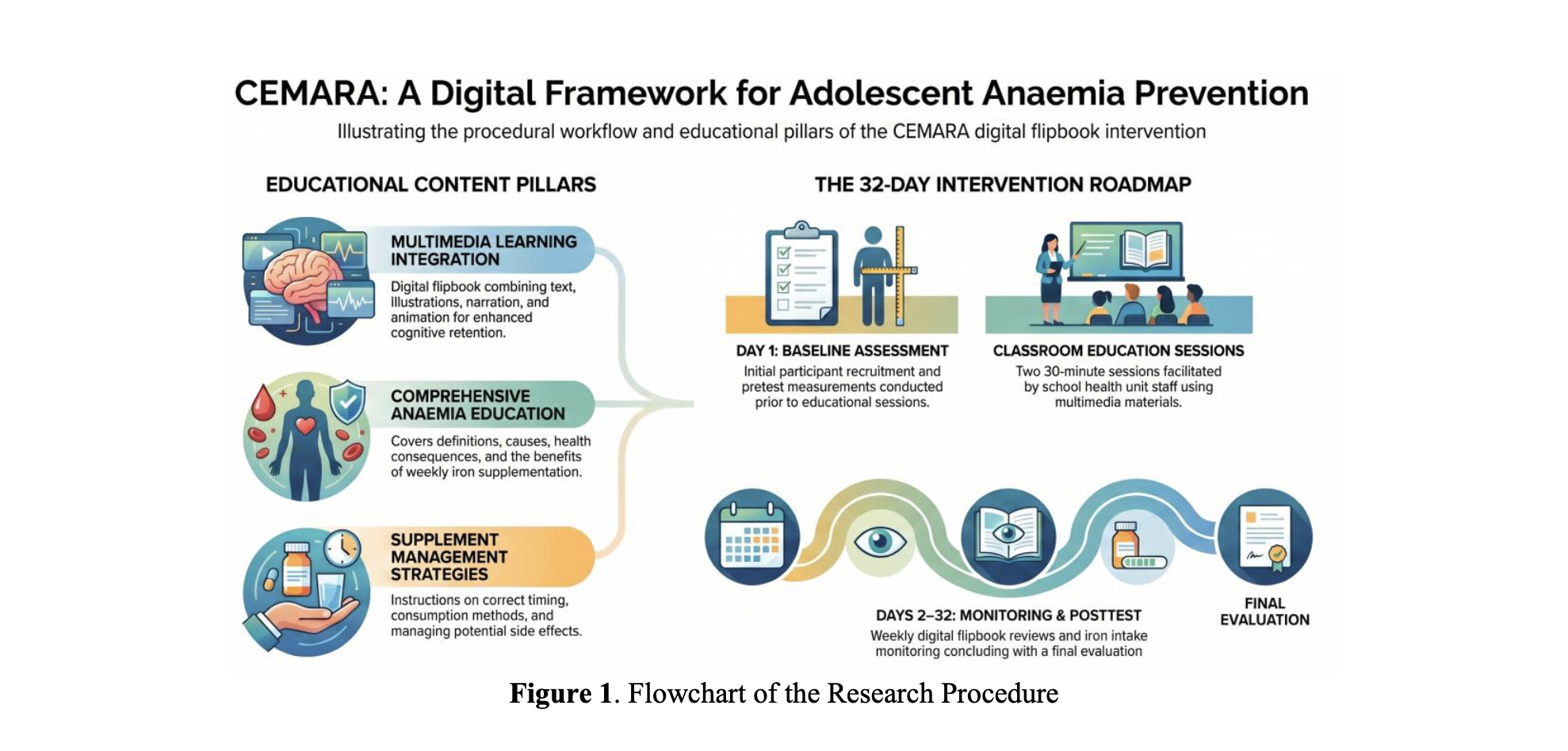
Anemia remains a significant public health problem among adolescent girls in Indonesia, with low adherence to weekly iron-folic acid supplementation (IFAS) programs. Innovative educational strategies are needed to improve both knowledge and adherence to supplementation. This study aimed to examine the effect of CEMARA animated flipbook education on knowledge and weekly iron supplement adherence among anemic adolescent girls. A pre-experimental one-group pretest-posttest design was used. The study involved 68 ninth-grade anemic girls from SMPN 03 Bukittinggi, Indonesia. Consecutive sampling was applied to recruit participants. The intervention consisted of the CEMARA animated flipbook, which was delivered over one month. During this period, the girls also received weekly monitoring of their iron tablet intake. Knowledge and adherence were measured using structured questionnaires, both of which had acceptable reliability (Cronbach's alpha = 0.812 for knowledge and 0.803 for adherence). Data analysis was performed using the Wilcoxon signed-rank test and Spearman's rank correlation test. The mean knowledge score increased from 12.90 ± 2.306 to 19.13 ± 1.683 (p < 0.001). The mean adherence score increased from 3.56 ± 1.028 to 5.84 ± 1.016 (p < 0.001). However, the correlation between knowledge improvement and adherence was weak and not statistically significant (r = 0.171; p = 0.162). CEMARA animated flipbook education significantly improved knowledge and weekly iron supplement adherence among anemic adolescent girls. However, increased knowledge was not significantly associated with adherence, indicating that behavioral and contextual factors may also influence supplementation practices.
References
Ajzen, I., 1991. The theory of planned behavior. Organizational Behavior and Human Decision Processes, 50(2), pp.179–211. https://doi.org/10.1016/0749-5978(91)90020-T
Bandura, A., 2004. Health promotion by social cognitive means. Health Education & Behavior, 31(2), pp.143–164. https://doi.org/10.1177/1090198104263660
Benson, T., Patton, M. and Smith, J., 2021. Barriers and facilitators of adherence to iron supplementation among adolescents: a systematic review. Public Health Nutrition, 24(18), pp.6086–6098. https://doi.org/10.1017/S1368980021002997
Bhutta, Z.A., Das, J.K., Rizvi, A., et al., 2013. Evidence-based interventions for improvement of maternal and child nutrition. The Lancet, 382(9890), pp.452–477. https://doi.org/10.1016/S0140-6736(13)60996-4
Black, R.E., Victora, C.G., Walker, S.P., et al., 2021. Maternal and child undernutrition and overweight in low- and middle-income countries. The Lancet, 397(10282), pp.144–155. https://doi.org/10.1016/S0140-6736(21)00039-8
Chaudhary, A., Sudzina, F. and Mikkelsen, B.E., 2022. Promoting healthy eating among adolescents through digital interventions: a systematic review. Nutrients, 14(3), p.604. https://doi.org/10.3390/nu14030604
Conover, W.J., 1999. Practical nonparametric statistics. 3rd ed. New York: John Wiley & Sons. Available at: https://onlinelibrary.wiley.com/doi/book/10.1002/9780470523995
Das, J.K., Salam, R.A., Thornburg, K.L., et al., 2022. Nutrition in adolescents: physiology, metabolism, and interventions. The Lancet Child & Adolescent Health, 6(1), pp.46–58. https://doi.org/10.1016/S2352-4642(21)00333-1
De-Regil, L.M., Suchdev, P.S., Vist, G.E., et al., 2013. Intermittent iron supplementation for improving nutrition. Cochrane Database of Systematic Reviews, 7, CD009218. https://doi.org/10.1002/14651858.CD009218.pub3
Fernandez-Gaxiola, A.C. and De-Regil, L.M., 2019. Intermittent iron supplementation for reducing anaemia. Cochrane Database of Systematic Reviews, 1, CD009218. https://doi.org/10.1002/14651858.CD009218.pub3
Galloway, R., Dusch, E., Elder, L., et al., 2002. Women’s perceptions of iron deficiency and anemia. Social Science & Medicine, 55(4), pp.529–544. https://doi.org/10.1016/S0277-9536(01)00185-6
Ghasemi, A. and Zahediasl, S., 2012. Normality tests for statistical analysis: a guide for non-statisticians. International Journal of Endocrinology and Metabolism, 10(2), pp.486–489. https://doi.org/10.5812/ijem.3505
Glanz, K., Rimer, B.K. and Viswanath, K., 2015. Health behavior: theory, research, and practice. 5th ed. San Francisco: Jossey-Bass.
Hernandez, K., Leung, C. and Lee, A., 2021. Multimedia-based health education interventions among adolescents: a review. Journal of Adolescent Health, 69(4), pp.567–575. https://doi.org/10.1016/j.jadohealth.2021.04.015
Hurrell, R., Egli, I. and others, 2010. Iron bioavailability and dietary reference values. International Journal for Vitamin and Nutrition Research, 80(4–5), pp.299–311. https://doi.org/10.1024/0300-9831/a000036
Kassebaum, N.J., Jasrasaria, R., Naghavi, M., et al., 2014. A systematic analysis of global anemia burden. Blood, 123(5), pp.615–624. https://doi.org/10.1182/blood-2013-06-508325
Keats, E.C., Rappaport, A.I., Shah, S., et al., 2024. Effective interventions to improve adolescent nutrition: a systematic review. BMJ Global Health, 9, e012345. https://doi.org/10.1136/bmjgh-2024-012345
Kementerian Kesehatan Republik Indonesia, 2023. Buku saku pencegahan anemia pada remaja putri. Jakarta: Kementerian Kesehatan RI. Available at: https://promkes.kemkes.go.id
Kementerian Kesehatan Republik Indonesia, 2024. Survei Kesehatan Indonesia 2023 dalam angka. Jakarta: Kementerian Kesehatan RI. Available at: https://www.badankebijakan.kemkes.go.id
Lemeshow, S., Hosmer, D.W., Klar, J. and Lwanga, S.K., 1990. Adequacy of sample size in health studies. Geneva: World Health Organization. Available at: https://apps.who.int/iris/handle/10665/41607
Low, M.S.Y., Speedy, J., Styles, C.E., et al., 2021. Daily iron supplementation adherence and associated factors. The American Journal of Clinical Nutrition, 113(2), pp.373–382. https://doi.org/10.1093/ajcn/nqaa347
Mayer, R.E., 2009. Multimedia learning. 2nd ed. Cambridge: Cambridge University Press. https://doi.org/10.1017/CBO9780511811678
Michie, S., van Stralen, M.M. and West, R., 2018. The behaviour change wheel. Implementation Science, 13, p.42. https://doi.org/10.1186/s13012-018-0751-0
Mistry, S.K., Rahman, M., Yadav, U.N., et al., 2022. Determinants of iron supplementation adherence. BMC Public Health, 22, p.1564. https://doi.org/10.1186/s12889-022-14021-0
Nguyen, P.H., Scott, S., Avula, R., et al., 2023. Effectiveness of digital nutrition education interventions in adolescents: a meta-analysis. The Journal of Nutrition, 153(4), pp.1123–1135. https://doi.org/10.1016/j.tjnut.2023.01.012
Nguyen, P.H., Avula, R., Headey, D., et al., 2024. Digital platforms for improving adolescent nutrition outcomes. Nutrients, 16(1), p.123. https://doi.org/10.3390/nu16010123
Pasricha, S.R., Tye-Din, J., Muckenthaler, M.U. and Swinkels, D.W., 2021. Iron deficiency. The Lancet Haematology, 8(6), pp.e457–e474. https://doi.org/10.1016/S2352-3026(21)00152-2
Polit, D.F. and Beck, C.T., 2021. Nursing research: generating and assessing evidence for nursing practice. 11th ed. Philadelphia: Wolters Kluwer. Available at: https://shop.lww.com/Nursing-Research/p/9781975110648
Salam, R.A., Hooda, M., Das, J.K., et al., 2013. Interventions to improve adolescent nutrition. Journal of Adolescent Health, 52(S2), pp.S29–S39. https://doi.org/10.1016/j.jadohealth.2012.05.015
Srivastava, S., Kumar, P., Paul, R. and Debnath, P., 2022. Prevalence and determinants of anemia among adolescents. BMC Public Health, 22, p.13863. https://doi.org/10.1186/s12889-022-13863-w
Stevens, G.A., Paciorek, C.J., Flores-Urrutia, M.C., et al., 2022. National, regional, and global estimates of anaemia. The Lancet Global Health, 10(5), pp.e627–e639. https://doi.org/10.1016/S2214-109X(22)00084-5
Stevens, G.A., Stevens, L.M., et al., 2024. Global trends in anaemia. The Lancet Global Health, 12(1), pp.e10–e20. https://doi.org/10.1016/S2214-109X(24)00001-0
Tamiru, D., Argaw, A., Gerbaba, M. and Nigussie, A., 2017. School-based nutrition education interventions. Public Health Nutrition, 20(8), pp.1501–1510. https://doi.org/10.1017/S1368980016003859
Tavakol, M. and Dennick, R., 2011. Making sense of Cronbach’s alpha. International Journal of Medical Education, 2, pp.53–55. https://doi.org/10.5116/ijme.4dfb.8dfd
World Health Organization, 2023. Guideline on iron supplementation in adolescents. Geneva: WHO. Available at: https://www.who.int/publications
World Health Organization, 2024. Anaemia. Available at: https://www.who.int/news-room/fact-sheets/detail/anaemia
World Medical Association, 2013. Declaration of Helsinki: ethical principles for medical research involving human subjects. JAMA, 310(20), pp.2191–2194. https://doi.org/10.1001/jama.2013.281053
Downloads
Published
Issue
Section
License
Copyright (c) 2026 Jurnal Ners dan Kebidanan (Journal of Ners and Midwifery)

This work is licensed under a Creative Commons Attribution-ShareAlike 4.0 International License.