Scoping Review: The Role of Family Emotional Support in Reducing the Risk of Baby Blues among Postpartum Mothers
DOI:
https://doi.org/10.26699/jnk..v13i2.ART.p147-159Keywords:
Family Emotional Support, Baby Blues, Postpartum Mothers, Maternal Mental Health, Social SupportAbstract
The postpartum period is a sensitive transitional phase that may trigger
emotional changes known as baby blues syndrome. This scoping review
aims to explore and map the existing scientific evidence regarding the role
of family emotional support in reducing the risk of baby blues among
postpartum mothers. Following the PRISMA-ScR guidelines, a
comprehensive literature search was conducted on PubMed and
ScienceDirect databases for articles published between 2020 and 2025. Out
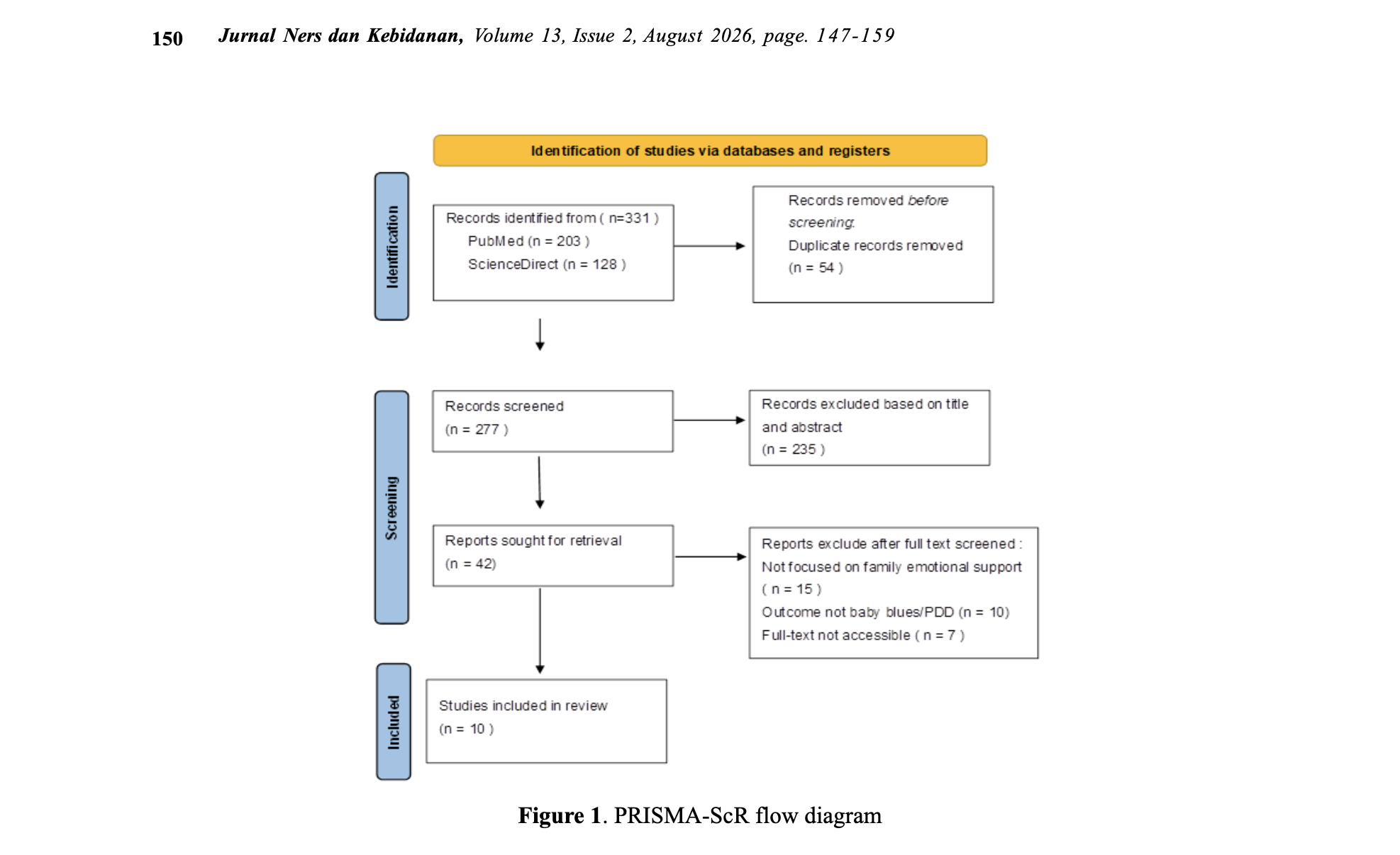
of 331 identified articles, 10 open-access primary studies met the inclusion
criteria and were analyzed narratively. he results indicate that emotional
support from close family members, particularly husbands and parents, plays
a significant role in helping mothers adapt psychologically. Key barriers to
optimal support include social stigma surrounding maternal mental health,
weak family communication, and a lack of standardized screening protocols
in healthcare facilities. Conversely, crucial facilitators include active spousal
involvement in infant care, family-centered psychoeducation, and the
utilization of digital health platforms. In conclusion, family emotional
support serves as a vital protective factor that strengthens maternal
psychological resilience and prevents the progression of baby blues into
postpartum depression. Based on these findings, it is suggested that
healthcare frameworks formally integrate family-based education into
postnatal care, provide continuous empathetic communication training for
healthcare providers, and strengthen community-based peer support
initiatives.
References
Almutairi, H. A., Alyousef, S. M., Alhamidi, S. A.,
& Almoammar, D. N. (2023). Exploring the
Healthcare Services’ Contribution to
Reducing Postpartum Depression. SAGE
Open Nursing, 9.
https://doi.org/10.1177/23779608231171780
Anggraeni, L. (2024). Perspektif Global Kesehatan
Mental Kaum Pemuda (Remaja, Adolesen &
Dewasa Awal) Di Amerika Serikat, Eropa,
Negara Persemakmuran & Asia Tenggara
Tahun 2024: Sebuah Tinjauan Pustaka
Sistematis. Jurnal Ilmu Kesehatan Karya
Bunda Husada, 10(2), 34–61.
https://doi.org/10.56861/jikkbh.v10i2.140
Anggraini, R., & Setiyowati, N. (2024). Budaya dan
Intervensi Depresi Postpartum : Tinjauan
Literatur Sistematik Lintas Benua. Jurnal
Psikologi, 1, 1–20.
https:/doi.org/2010.47134/pjp.v2i1.3240
Aurora, W. I. D., Rahmawati, D., & Sulistiawan, A.
(2026). Pemberdayaan Kader PKK dan
Keluarga melalui Program Gerakan
Masyarakat Peduli Kesehatan Mental Ibu (
GEMAPI ) untuk Pencegahan Depresi
Postpartum. Jurnal Medika: Medika, 5(1),
195–205. https://doi.org/10.31004/yv6js232
Bhushan, N. L., Stockton, M. A., Harrington, B. J.,
DiPrete, B. L., Maliwichi, M., Jumbe, A. N.,
Kulisewa, K., Chagomerana, M. B., Pence, B.
W., Gaynes, B. N., & Hosseinipour, M. C.
(2022). Probable perinatal depression and
social support among women enrolled in
Malawi’s Option B+ Program: A longitudinal
analysis. Journal of Affective Disorders,
306(November 2021), 200–207.
https://doi.org/10.1016/j.jad.2022.03.017
Carter, M., Russolillo, A., Ou, C., Zusman, E. Z.,
Hall, W. A., Cheung, I. W., & Jenkins, E.
(2025). Models and key elements of
integrated perinatal mental health care: A
scoping review. PLOS Mental Health, 2(3),
e0000164.
https://doi.org/10.1371/journal.pmen.000016
4
Dansu, M. A. (2024). Virtual Peer Support: Impact
of Online Social Interactions Among
Members of a Japanese Single Mothers’
Community. Voluntas, 35(6), 1167–1177.
https://doi.org/10.1007/s11266-024-00681-4
Diyaolu, C. O. (2025). Advancing maternal , child ,
and mental health equity : A communitydriven model for reducing health disparities
and strengthening public health resilience in
underserved U.S. communities. World
Journal of Advanced Research and Reviews.
https://doi.org/10.30574/wjarr.2025.26.3.22
64
Gulbransen, K., Thiessen, K., Ford, N., Beck, W. P.,
Watson, H., & Gregory, P. (2024).
Interprofessional Care Models for Pregnant
and Early-Parenting Persons Who Use
Substances: A Scoping Review. International
Journal of Integrated Care, 24(2), 1–14.
https://doi.org/10.5334/ijic.7589
Hanach, N., Saqan, R., Radwan, H., Baniissa, W., &
de Vries, N. (2024). Perceived Experiences
and Needs of Digital Resources Among
Postpartum Women in the United Arab
Emirates: Qualitative Focus Group Study.
Journal of Medical Internet Research, 26.
Khademi, K., & Kaveh, M. H. (2024). Social
support as a coping resource for psychosocial
conditions in postpartum period: a systematic
review and logic framework. BMC
Psychology, 12(1), 1–12.
https://doi.org/10.1186/s40359-024-01814-6
Khademi, K., Kaveh, M. H., & Karimi, M. (2023).
The impact of family social support on
postpartum quality of life among Iranian
women : structural equation modelling.
https://doi.org/10.1177/03000605221147198
Kim, S., Kim, D. J., Lee, M., & Lee, H. (2023).
Association of Social Support and
Postpartum Depression According to the
Time After Childbirth in South Korea. 750–
757.Kress, V. E., Steudte‐Schmiedgen, S., Kopp, M.,
Förster, A., Altus, C., Schier, C., Wimberger,
P., Kirschbaum, C., Soest, T. von, Weidner,
K., Junge‐Hoffmeister, J., & Garthus‐Niegel,
S. (2019). The Impact of Parental Role
Distributions, Work Participation, and Stress
Factors on Family Health-Related Outcomes:
Study Protocol of the Prospective MultiMethod Cohort “Dresden Study on Parenting,
Work, and Mental Health” (DREAM).
Frontiers in Psychology.
https://doi.org/10.3389/fpsyg.2019.01273
Liblub, S., Pringle, K., McLaughlin, K., &
Cummins, A. (2024). Peer support and
mobile health for perinatal mental health: A
scoping review. Birth, 51(3), 484–496.
https://doi.org/10.1111/birt.12814
Luciano, M., Di Vincenzo, M., Brandi, C., Tretola,
L., Toricco, R., Perris, F., Volpicelli, A.,
Torella, M., La Verde, M., Fiorillo, A., &
Sampogna, G. (2022). Does antenatal
depression predict post-partum depression
and obstetric complications? Results from a
longitudinal, long-term, real-world study.
Frontiers in Psychiatry, 13.
https://doi.org/10.3389/fpsyt.2022.1082762
Luciano, M., Sampogna, G., Vecchio, V. Del,
Giallonardo, V., Perris, F., Carfagno, M.,
Raia, M. L., Vincenzo, M. Di, Verde, M. La,
Torella, M., & Fiorillo, A. (2021). The
Transition From Maternity Blues to FullBlown Perinatal Depression : Results From a
Longitudinal Study. 12(November), 1–9.
https://doi.org/10.3389/fpsyt.2021.703180
Machado, T. D. S., Chur-hansen, A., & Due, C.
(2020). First-time mothers ’ perceptions of
social support : Recommendations for best
practice.
https://doi.org/10.1177/2055102919898611
Mahardhika, G. P. C. (2025). Pengaruh Dukungan
Emosional dan Komunikasi Positif Suami
terhadap Kejadian Postpartum Depression
pada Ibu Nifas. Bunda Edu-Midwifery
Journal (BEMJ), 8, 934–939.
https://doi.org/10.54100/bemj.v8i2.638
Maliwichi, M., Jumbe, A. N., Kulisewa, K., &
Chagomerana, M. B. (2023). enrolled in
Malawi ’ s Option B + Program : a
longitudinal analysis. 200–207.
https://doi.org/10.1016/j.jad.2022.03.017.Pr
obable
Modak, A., Ronghe, V., Gomase, K. P.,
Mahakalkar, M. G., & Taksande, V. (2023a).
A Comprehensive Review of Motherhood and
Mental Health : Postpartum Mood Disorders
in Focus. 15(9).
https://doi.org/10.7759/cureus.46209
Modak, A., Ronghe, V., Gomase, K. P.,
Mahakalkar, M. G., & Taksande, V. (2023).
A Comprehensive Review of Motherhood
and Mental Health: Postpartum Mood
Disorders in Focus. Cureus, 15(9).
https://doi.org/10.7759/cureus.46209
Norazman, C. W., & Lee, L. K. (2024). The
influence of social support in the prevention
and treatment of postpartum depression : An
intervention-based narrative review.
https://doi.org/10.1177/17455057241275587
Nurcholidah, L., Haryono, T., Sunaryo, S., &
Hendarsjah, H. (2023). Work Family
Conflict, Job Stress and Employee
Engagement on Innovation Work Behavior:
Mediating Roles of Career Adaptability.
Journal of Law and Sustainable
Development.
https://doi.org/10.55908/sdgs.v11i5.1005
Rahmatina, A. N., Habut, F. J., Son, P. M. S., &
Adnani, Q. E. S. (2025). Hambatan Ibu
Mendapatkan Perawatan Depresi
Postpartum: Tinjauan Sistematis Studi
Kualitatif. Jurnal Sains Kebidanan, 7(1), 8–
21. https://doi.org/10.31983/jsk.v7i1.12310
Roman, N. V., Balogun, T. V., Butler-Kruger, L.,
Danga, S. D., Therese de Lange, J., HumanHendricks, A., Thelma Khaile, F., October,
K. R., & Olabiyi, O. J. (2025). Strengthening
Family Bonds: A Systematic Review of
Factors and Interventions That Enhance
Family Cohesion. Social Sciences, 14(6), 1–
31. https://doi.org/10.3390/socsci14060371Serinadi, D. M., Yudhawati, N. L. P. S., & Triyana
Puspa Dewi. (2025). Identifikasi Depresi
Postpartum Menggunakan Edinburgh
Postnatal Depression Scale Di Rs Tk Ii
Udayana. Jurnal Medika Usada, 8, 57–61.
https://doi.org/10.54107/medikausada.v8i2.4
14
Sharifipour, F., Javadnoori, M., Moghadam, Z. B.,
Najafian, M., & Cheraghian, B. (2022).
Interventions to improve social support
among postpartum mothers : A systematic
review. Tabriz University of Medical
Sciences, 12(2), 141–150.
https://doi.org/10.34172/hpp.2022.18
Sobczak, A., Taylor, L., Solomon, S., Ho, J.,
Kemper, S., Phillips, B., Jacobson, K.,
Castellano, C., Ring, A., Castellano, B., &
Jacobs, R. J. (2023). The Effect of Doulas on
Maternal and Birth Outcomes: A Scoping
Review. Cureus, 15(5), 1–13.
https://doi.org/10.7759/cureus.39451
Tessema, M., Abera, M., & Birhanu, Z. (2024).
Effectiveness of group-based psychoeducation on preventing postpartum
depression among pregnant women by
primary healthcare provider in primary
healthcare institution: a cluster-randomized
controlled trial. Frontiers in Psychiatry,
15(September), 1–15.
https://doi.org/10.3389/fpsyt.2024.1433942
Tosto, V., Ceccobelli, M., Lucarini, E., Tortorella,
A., Gerli, S., Parazzini, F., & Favilli, A.
(2023). Maternity Blues : A Narrative
Review.
Tricintiya, N. N., Salsabila, A., Putri, D. A.,
Luviana, A. S. P., Nuriy, S. N., Achdiani, Y.,
& Fatimah7, S. N. (2025). Penerapan
Mindful Family Talk untuk Meningkatkan
Empati dan Kesehatan Mental Keluarga.
Jurnal Penelitian Inovatif (JUPIN), 5(2),
1213–1218.
https://doi.org/10.54082/jupin.1444
Ulfa, H. M., & Algifahmy, A. F. (2025). Strategi
Bimbingan Konseling Islam dalam
Mencegah Kekerasan dalam Rumah Tangga
Berbasis Gender. Al-Hiwar: Jurnal Ilmu Dan
Teknik Dakwah, 13(1), 39–51.
https://doi.org/10.18592/alhiwar.v13i1.1439
4
Yamashita, A., Isumi, A., & Fujiwara, T. (2022).
Online Peer Support and Well-being of
Mothers and Children: Systematic Scoping
Review. Journal of Epidemiology, 32(2), 61–
68. https://doi.org/10.2188/jea.JE20200079
Yi, F., & Ahn, S. (2024). Effects of postpartum
fatigue , parenting stress , and family support
on postpartum depression in Chinese firsttime mothers : a cross-sectional study. 30(3),
226–237.
Yu, M., Washburn, M., Bayhi, J. L., Xu, W., Carr,
L., & Sampson, M. (2025). Home visiting for
postpartum depression. Cochrane Database
of Systematic Reviews, 2025(1).
https://doi.org/10.1002/14651858.CD01598
4
Zhang, G., Li, P., & Jia, Y. (2023). Relationship
between family cohesion/adaptability and
postpartum depressive symptoms: A singlecenter retrospective study. 13(2), 50–59.
https://doi.org/10.5498/wjp.v13.i2.50
Zhang, K., He, L., Li, Z., Ding, R., Han, X., Chen,
B., Cao, G., Ye, J., Li, T., & Fu, R. (2024).
Bridging Neurobiological Insights and
Clinical Biomarkers in Postpartum
Depression : A Narrative Review.
Downloads
Published
Issue
Section
License
Copyright (c) 2026 Jurnal Ners dan Kebidanan (Journal of Ners and Midwifery)

This work is licensed under a Creative Commons Attribution-ShareAlike 4.0 International License.