Determinants of Adolescents Pregnancy and the Incidence of Stunting in Children 24-59 Months of Age
DOI:
https://doi.org/10.26699/jnk..v13i1.ART.p093-105Keywords:
Adolescent Pregnancy, Determinants, Public Health, Stunting, 24-59 MonthsAbstract
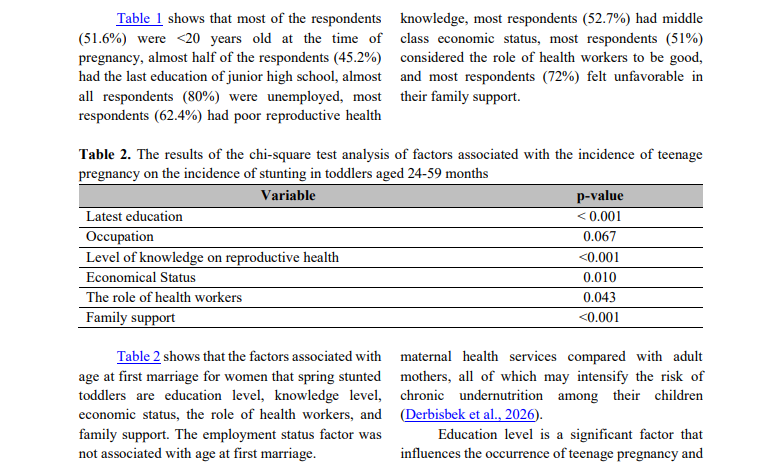
Adolescent pregnancy is a significant public health issue that can lead to various adverse outcomes, including stunting in children. This study aims to investigate the determinants of adolescent pregnancy and their association with the incidence of stunting in children aged 24-59 months at Poncokusumo Health Center, Malang Regency. The research employs a cross-sectional design, collecting primary data through interviews and secondary data from the Puskesmas Poncokusumo. The study includes 93 mothers of stunted toddlers with a history of adolescent pregnancy. The sampling technique used purposive sampling. Data were analyzed by chi-square.The analysis reveals significant relationships between educational level economic status, knowledge, the role of healthcare providers, and family support with the incidence of stunting, while employment status shows no significant correlation. The findings suggest that targeted interventions addressing these determinants could mitigate stunting rates among children born to adolescent mothers. Further research should explore the psychosocial impacts and long-term outcomes for these children, as well as the effectiveness of existing healthcare interventions
References
Apriliana, T., Keliat, B. A., Mustikasari, & Primasari, Y. (2022a). A contributing factor of maternal pregnancy depression in the occurrence of stunting on toddlers. Journal of Public Health Research, 11(2), 78–82. https://doi.org/10.4081/jphr.2021.2738
Ariati, L. I. P. (2019). Faktor-Faktor Resiko Penyebab Terjadinya Stunting Pada Balita Usia 23-59 Bulan. OKSITOSIN : Jurnal Ilmiah Kebidanan, 6(1), 28–37. https://doi.org/10.35316/oksitosin.v6i1.341
Ayue, H. I., Nurdiana, N., Wardhani, V., Astuti, A. B., Prayitno, H., Laksono, A. D., & Sundjaya, T. (2025). Exploring the multifactorial predictors of stunting in children under five: A systematic review of the literature, 2015–2024. Journal of Public Health Research, 14(4). https://doi.org/10.1177/22799036251403945
Azis, R., Rafai, M., & Setiahati, N. K. (2021). Analisis Faktor Risiko Ibu dan Anak Balita Terhadap Stunting Di Wilayah Kerja Puskesmas Sangurara. PREPOTIF Jurnal Kesehatan Masyarakat, 5(2), 870–881.
Bloem, M. W., de Pee, S., Hop, L. T., Khan, N. C., Laillou, A., Minarto, Moench-Pfanner, R., Soekarjo, D., Soekirman, Solon, J. A., Theary, C., & Wasantwisut, E. (2013). Key strategies to further reduce stunting in Southeast Asia: lessons from the ASEAN countries workshop. Food and Nutrition Bulletin, 34(2 Suppl), 8–16. https://doi.org/10.1177/15648265130342s103
Darojat, B. Z., Katmawanti, S., Paramita, F., Kurniawan, A., & Hamzah, S. H. (2023). The Correlation between Knowledge, Attitude, and Behavior of Responsive Feeding on Stunting Incidents in Children in Karangploso Health Center, Malang Regency, Indonesia. E3S Web of Conferences, 448, 1–10. https://doi.org/10.1051/e3sconf/202344801017
Derbisbek, S. B., Abduldayeva, A. A., Delellis, N., Khamidullina, Z. G., & Kalen, D. (2026). The Adverse Maternal Outcomes and Risk Factors of Adolescent Pregnancy: Evidence From a Retrospective Study in Astana, Kazakhstan. International Journal of Public Health, 70. https://doi.org/10.3389/ijph.2025.1608992
Erfina, E., Hariati, S., Tawali, S., Nurmaulid, N., Safari, K., & McKenna, L. (2025). Development and evaluation of blended interventions to prevent stunting in children of adolescent mothers: A mixed methods study. Journal of Pediatric Nursing, 85, 697–705. https://doi.org/10.1016/j.pedn.2025.10.003
Fallo, M. V., Nur, M. L., & Ndoen, E. (2023). Hubungan Antara Pengetahuan Gizi Dan Pola Asuh Ibu Dengan Kejadian Stunting Di Wilayah Kerja Puskesmas Bijaepasu Kabupaten Timor Tengah Utara. Promotif : Jurnal Kesehatan Masyarakat, 13(2), 107–115. https://doi.org/10.56338/promotif.v13i2.4120
Fernandes, E. C. B., de Castro, T. G., & Sartorelli, D. S. (2017). Associated factors of malnutrition among African children under five years old, Bom Jesus, Angola. Revista de Nutricao, 30(1), 33–44. https://doi.org/10.1590/1678-98652017000100004
Finlay, J. E., Norton, M. K., & Guevara, I. M.-. (2017). Adolescent Fertility and Child Health: The Interaction of Maternal Age, Parity and Birth Intervals in Determining Child Health Outcomes. International Journal of Child Health and Nutrition, 6(1), 16–33. https://doi.org/10.6000/1929-4247.2017.06.01.2
Handayani, F., Siagian, A., & Aritonang, E. Y. (2017). Mother’s Education as A Determinant of Stunting among Children of Age 24 to 59 Months in North Sumatera Province of Indonesia. IOSR Journal of Humanities and Social Science, 22(06), 58–64. https://doi.org/10.9790/0837-2206095864
Harahap, N., Made Ali, R. S., & J. Hadi, A. (2023). Pengaruh Pola Asuh dan Karakteristik Ibu terhadap Stunting di Wilayah Kerja Puskesmas Pintu Padang Kabupaten Tapanuli Selatan. Media Publikasi Promosi Kesehatan Indonesia (MPPKI), 6(11), 2304–2314. https://doi.org/10.56338/mppki.v6i11.4298
Ida Hannum, Anto J. Hadi, Owildan Wisudawan B, Haslinah Ahmad, & Zuraidah Nasution. (2023). Review Kejadian Stunting pada Anak Baduta di Wilayah Kerja Puskesmas Paringgonan Kabupaten Padang Lawas. Media Publikasi Promosi Kesehatan Indonesia (MPPKI), 6(6), 1187–1192. https://doi.org/10.56338/mppki.v6i6.3638
Ishomuddin, M., Ningtyias, F. W., & Ratnawati, L. Y. (2024). Analisis Determinan Stunting Pada Balita Usia 24-59 Bulan Di Daerah Perkebunan (Studi Di Desa Silo Kecamatan Silo Kabupaten Jember). Journal of Nutrition College, 13(1), 59–68. https://doi.org/10.14710/jnc.v13i1.40899
Juniarti, N., Alsharaydeh, E., Sari, C. W. M., Yani, D. I., & Hutton, A. (2025). Determinant factors influencing stunting prevention behaviors among working mothers in West Java Province, Indonesia: a cross-sectional study. BMC Public Health, 25(1), 2719. https://doi.org/10.1186/s12889-025-24078-0
Laksono, A. D., Sukoco, N. E. W., Rachmawati, T., & Wulandari, R. D. (2022). Factors Related to Stunting Incidence in Toddlers with Working Mothers in Indonesia. International Journal of Environmental Research and Public Health, 19(17). https://doi.org/10.3390/ijerph191710654
Lestari, E. D., Hasanah, F., & Nugroho, N. A. (2018). Correlation between non-exclusive breastfeeding and low birth weight to stunting in children. Paediatrica Indonesiana, 58(3), 123–127. https://doi.org/10.14238/pi58.3.2018.123-7
Lestari, E., Kusmadeni, D., & Sutinbuk, D. (2024). Hubungan Pola Asuh Ibu dengan Kejadian Stunting pada Balita Wilayah Kerja Puskesmas Rias 2022. Afiasi : Jurnal Kesehatan Masyarakat, 8(3), 550–558. https://doi.org/10.31943/afiasi.v8i3.306
Mahfujiah, F., Hanifa, F., & Ginting, A. S. B. (2022). Hubungan status gizi, pola makan dan riwayat pemberian asi ekslusif dengan kejadian stunting pada anak pra sekolah 3-5 tahun. THE JOURNAL OF Mother and Child Health Concerns, 1(2), 50–56. https://doi.org/10.56922/mchc.v1i2.270
Mariyami, T., & Sanjaya, R. (2022). Hubungan BBLR dan Status Pemberian ASI Dengan Kejadian Stunting pada Baduta. Journal of Current Health Sciences, 2(1), 13–18. https://doi.org/10.47679/jchs.202231
Nafisah, K. durrotun, & Christiana, I. (2025). Maternal Characteristics Associated with stunting Incidence: A Cross-Sectional Study. Women, Midwives and Midwifery, 5(2), 48–59. https://doi.org/10.36749/wmm.5.2.48-59.2025
Nasution, I. P. A., & Manik, B. S. I. G. (2020). Tingkat Pengetahuan, Sikap, dan Perilaku Remaja tentang Kesehatan Reproduksi di SMK Negeri 8 Medan. SCRIPTA SCORE Scientific Medical Journal, 2(1), 38–43. https://doi.org/10.32734/scripta.v2i1.3424
Naufi, B., Amanah, S., & Fatchiy, A. (2021). Pengetahuan Dan Sikap Remaja Anggota Pusat Informasi Dan Konseling Remaja Terhadap Tiga Risiko Ancaman Dasar Kesehatan Reproduksi. Jurnal Kommunity Online, 2(1), 65–73. https://doi.org/10.15408/jko.v2i1.21893
Nguyen, P. H., Scott, S., Neupane, S., Tran, L. M., & Menon, P. (2019). Social, biological, and programmatic factors linking adolescent pregnancy and early childhood undernutrition: a path analysis of India’s 2016 National Family and Health Survey. The Lancet Child and Adolescent Health, 3(7), 463–473. https://doi.org/10.1016/S2352-4642(19)30110-5
Pertiwi, T. I. (2018). Gambaran Tingkat Pengetahuan Dan Praktik Menstrual Hygiene Pada Siswi Sdn 4 Pacarkembang Surabaya. Jurnal PROMKES, 6(2), 142. https://doi.org/10.20473/jpk.v6.i2.2018.142-154
Pristya, T. Y. R., Fitri, A. M., & Wahyuningtyas, W. (2021). Literature Review: Gizi Antenatal terhadap Kejadian Stunting. Jurnal Kesehatan, 12(2), 314. https://doi.org/10.26630/jk.v12i2.2261
Putri, T. A., Salsabilla, D. A., Muthi’ah, T. S., Vergawita, T., & Komisah, K. (2025). The Relationship Between Maternal Nutritional Status and the Incidence of Stunting: A Meta-Analysis. Journal of Maternal and Child Health, 10(2), 73–84. https://doi.org/10.26911/thejmch.2025.01.02.02
Rahayu, D. T. (2021). Anemia Pada Kehamilan Dengan Kejadian Stunting Di Desa Gayam Kecamatan Gurah Kabupaten Kediri. Midwiferia: Jurnal Kebidanan, 7(1), 81–94. https://doi.org/10.21070/midwiferia.v
Rahmadiani, I., Fibriana, A. I., Azam, M., Health, P., & Program, S. (2024). Low Birth Weight Is Related To Stunting Incidents: Indonesian Nutrition Status Survey Data Analysis. https://doi.org/10.1101/2024.06.10.24308684
Ramadani, M., Nursal, D. G. A., & Ramli, L. (2015). Peran Tenaga Kesehatan dan Keluarga dalam Kehamilan Usia Remaja. Kesmas: National Public Health Journal, 10(2), 87. https://doi.org/10.21109/kesmas.v10i2.885
Rochmawati, R., Petricka, G., Kusmintarti, A., Gunadarma, U., & Depok, K. (2023). The effectivity of hypnobreastfeeding on the success of exclusive breastfeeding by mothers giving birth at Dian Dwi Anggraini Independent Midwifery Practice in Bogor Regency. JNKI (Jurnal Ners Dan Kebidanan Indonesia) (Indonesian Journal of Nursing and Midwifery), 11(1), 79–85.
Romadhona, M. K., Khasanah, S. U., Ariadi, S., Kinasih, S. E., & Tjitrawati, A. T. (2023a). Re-defining stunting in Indonesia 2022: A comprehensive review. Jurnal Inovasi Ilmu Sosial Dan Politik (JISoP), 5(1), 56–63. https://doi.org/10.33474/jisop.v5i1.19741
Setyarini, D. I., Triningsih, R. W., & Aryani, H. R. (2022). Teenage Pregnancy in Malang: The Analysis on Stunting Incidence in Toddler Aged 24-59 Months. Journal of Maternal and Child Health, 7(5), 550–558. https://doi.org/10.26911/thejmch.2022.07.05.06
Simbolon, D., Jumiyati, J., Ningsih, L., & Riastuti, F. (2021). Is there a Relationship Between Pregnant Women’s Characteristics and Stunting Incidence In Indonesia? Jurnal Kesehatan Masyarakat, 16(3), 331–339. https://doi.org/10.15294/kemas.v16i3.23550
Sukmaningsih, W. R., Nugraheni, S. A., & Kartini, A. (2018). Pengaruh Film Pendek melalui Peer Educator terhadap Perilaku Remaja SMA terkait Kesehatan Reproduksi di Kota Semarang. Jurnal Manajemen Kesehatan Indonesia, 6(1), 50–59. https://doi.org/10.14710/jmki.6.1.2018.50-59
Sulistyawati, F., Melinda, A., & Ratnasari, R. (2024). The effect of maternal age on stunting incidence (Analysis of 2018 Riskesdas Secondary Data). JNKI (Jurnal Ners Dan Kebidanan Indonesia) (Indonesian Journal of Nursing and Midwifery), 12(1), 1. https://doi.org/10.21927/jnki.2024.12(1).1-10
Supariasa, I. D. N., Fajar, I., Khairuddin, K., & Adelina, R. (2023a). Analyzing Nutritional Factors that Affect Toddler’s Stunting in Malang Regency, Indonesia. Open Access Macedonian Journal of Medical Sciences, 11(E), 59–69. https://doi.org/10.3889/oamjms.2023.10199
Suwoyo, S., Pritasari, B., & Rahmaningtyas, I. (2021). Historical Relationship with Adolescent Pregnancy Stunting Events in Children Age 24-60 Months in Pranggang Village, Kediri District. Journal for Quality in Public Health, 4(2), 233–238. https://doi.org/10.30994/jqph.v4i2.214
Tesfaw, L. M., & Dessie, Z. G. (2022). Multilevel multivariate analysis on the anthropometric indicators of under-five children in Ethiopia: EMDHS 2019. BMC Pediatrics, 22(1), 1–13. https://doi.org/10.1186/s12887-022-03172-x
Tiwari, R., Ausman, L. M., & Agho, K. E. (2014). Determinants of stunting and severe stunting among under-fives: Evidence from the 2011 Nepal Demographic and Health Survey. BMC Pediatrics, 14(1), 1–15. https://doi.org/10.1186/1471-2431-14-239
Vir, S. C. (2016). Improving women’s nutrition imperative for rapid reduction of childhood stunting in South Asia: Coupling of nutrition specific interventions with nutrition sensitive measures essential. Maternal and Child Nutrition, 12, 72–90. https://doi.org/10.1111/mcn.12255
Wani Damanik, D., Saragih, J., & Ramayanti Purba, E. (2023). Edukasi Kesehatan Tentang Kesehatan Reproduksi pada Remaja di Dusun I Manik Hataran Simalungun. Jukeshum: Jurnal Pengabdian Masyarakat, 3(1), 118–123. https://doi.org/10.51771/jukeshum.v3i1.487
Woldesenbet, B., Tolcha, A., & Tsegaye, B. (2023). Water, hygiene and sanitation practices are associated with stunting among children of age 24-59 months in Lemo district, South Ethiopia, in 2021: community based cross sectional study. BMC Nutrition, 9(1), 1–9. https://doi.org/10.1186/s40795-023-00677-1
Yulika, M., Afrainin Syah, N., & . Y. (2024a). The Influence of Maternal Factors on the Incidence of Stunting in Toddlers: A Narrative Review. International Journal of Research and Review, 11(5), 693–702. https://doi.org/10.52403/ijrr.20240580
Zulu, C., Mbithe, D., & Ogada, I. (2023). Demographic-Socioeconomic Determinants of Nutritional Status among Children Ages 6-59 months from Female Headed Households in Luapula Valley, Zambia. Acta Scientifci Nutritional Health, 7(1), 83–95. https://doi.org/10.31080/asnh.2022.07.1173
Downloads
Published
Issue
Section
License
Copyright (c) 2026 Jurnal Ners dan Kebidanan (Journal of Ners and Midwifery)

This work is licensed under a Creative Commons Attribution-ShareAlike 4.0 International License.