Description of Stress Level of Diabetes Mellitus Patients with Hyperglycemia
DOI:
https://doi.org/10.26699/jnk..v13i1.ART.p028-039Keywords:
DASS-42, Diabetes Melitus, Hyperglycemia, StressAbstract
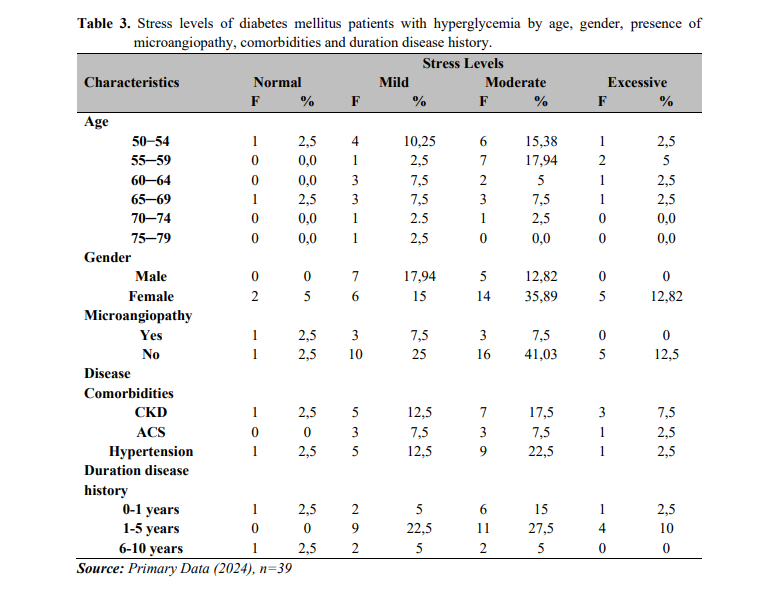
Diabetes mellitus with hyperglycemia is a concern because it can cause short-term and long-term complications. Ineffective stress management can affect the difficulty of controlling blood sugar levels. The purpose of this study was to describe of the stress level of diabetes mellitus patients with hyperglycemia. The research design method used a quantitative descriptive, with a purposive sampling technique and the total sample 39 respondents with inclusion criteria, namely that patients with hyperglycemia with their blood sugar levels ≥ 250 mg/dl and accompanied by comorbidities such as stroke, Chronic Kidney Disease (CKD), or acute coronary syndrome. The data collection instrument used is DASS−42 questionnaire sheet consists of 14 stress statement with a total of 42 questions with indicator difficulties in relaxing, nerve passion, and easily sad or agitation, and impatience. 0 assessment if yo never, score 1 if sometimes, score 2 if often, score 3 if always. The results were grouped when the normal stress was: 0−14, mild stress: 15−18, moderate stress: 19−25, severe stress: 26−33, dan very hard: >34. Based on the results showed that 48.72% (19 people) had a moderate stress level category, mild stress of 33.33% (13 people), severe stress of 12.82% (5 people) and normal stress of 5.13% (2 people). Based on the results of this study, factors that cause moderate stress levels due to age factors, prolonged 1−5 years, and irregular treatment.
References
Alfianto, A. G., Ulfa, M., Kurniyanti, M. A., & Wicaksono, K. E. (2021). Tingkat Stres Penderita Diabetes Mellitus Tipe 2 di Wilayah Pedesaan Selama Pandemi Covid-19 Dalam Melakukan Manajemen Perawatan Diri. Jurnal Kesehatan Komunitas, 7(3), 354–359. https://doi.org/10.25311/keskom.vol7.iss3.975
Andoko, A., Pangesti, D. N., & Asmawarni, N. (2021). Hubungan stres dengan kadar gula darah penderita diabetes mellitus. Holistik Jurnal Kesehatan, 14(4), 573–580. https://doi.org/10.33024/hjk.v14i4.1583
Arunima. (2019). Pathophysiology of Stress A Review. International Journal of Research and Review, 6(5), 199–213.
Banday, M. Z., Sameer, A. S., & Nissar, S. (2020). Pathophysiology of diabetes: An overview. Avicenna Journal of Medicine, 10(04), 174–188. https://doi.org/10.4103/ajm.ajm_53_20
Chen, S., Cao, Z., Chen, W., Zhao, J., Jiao, L., Prettner, K., Kuhn, M., Pan, A., Bärnighausen, T. W., & Bloom, D. E. (2025). The global macroeconomic burden of diabetes mellitus. Nature Medicine, 32(January). https://doi.org/10.1038/s41591-025-04027-5
Dinas Kesehatan Provinsi Jawa Timur. (2022). Profil Kesehatan Provinsi Jawa Timur 2021.
Farmaki, P., Damaskos, C., Garmpis, N., Garmpi, A., Savvanis, S., & Diamantis, E. (2021). Complications of the Type 2 Diabetes Mellitus. Current Cardiology Reviews, 16(4), 249–251. https://doi.org/10.2174/1573403x1604201229115531
Hamdiana, L., Wahyudi, I., Pa’ni, D. M. Q., & Amrullah, M. (2025). The Relationship of Stress Level to Blood Sugar Levels in Diabetic Mellitus Patients at UPTD Puskesmas Terara. THRIVE Health Science Journal, 2(1), 29–36. https://doi.org/10.56566/thrive.v2i1.313
Harris, M. L., Oldmeadow, C., Hure, A., Luu, J., Loxton, D., & Attia, J. (2017). Stress increases the risk of type 2 diabetes onset in women: A 12-year longitudinal study using causal modelling. PLOS ONE, 12(2), 1–13. https://doi.org/10.1371/journal.pone.0172126
Hidayat, B., Ramadani, R. V., Rudijanto, A., Soewondo, P., Suastika, K., & Siu Ng, J. Y. (2022). Direct Medical Cost of Type 2 Diabetes Mellitus and Its Associated Complications in Indonesia. Value in Health Regional Issues, 28, 82–89. https://doi.org/https://doi.org/10.1016/j.vhri.2021.04.006
Huang, X., Wu, Y., Ni, Y., Xu, H., & He, Y. (2025). Global, regional, and national burden of type 2 diabetes mellitus caused by high BMI from 1990 to 2021, and forecasts to 2045: analysis from the global burden of disease study 2021. Frontiers in Public Health, 13(January), 1–12. https://doi.org/10.3389/fpubh.2025.1515797
Ingrosso, D. M. F., Primavera, M., Samvelyan, S., Tagi, V. M., & Chiarelli, F. (2023). Stress and Diabetes Mellitus: Pathogenetic Mechanisms and Clinical Outcome. Hormone Research in Paediatrics, 96(1), 34–43. https://doi.org/10.1159/000522431
Irman, V., & Saridewi, R. I. (2024). Relationship between Stress Levels and Blood Sugar Levels in Diabetes Mellitus Article information Abstract. Frontiers in Healthcare Research, 1(1), 65–68.
Kusumadewi, S., Wahyuningsih, H., Informatika, T., Indonesia, U. I., Indonesia, U. I., & Korespondensi, P. (2020). Model Sistem Pendukung Keputusan Kelompok Untuk Penilaian Gangguan Depresi , Kecemasan Dan Stress Berdasarkan Dass-42 Group Decision Support System Model For Assessment of Depression , Anxiety And Stress Disorders Based On DASS-42. 7(2), 219–228. https://doi.org/10.25126/jtiik.202071052
Laksono, H., Febriyanto, T., & Ningsih, L. (2023). Faktor Risiko Kejadian ESRD (End Stage Renal Disease) Pada Penderita Diabetes Melitus di RSHD Kota Bengkulu; Case Control Study. Journal of Nursing and Public Health, 11(1), 178–188. https://doi.org/10.37676/jnph.v11i1.4116
Leksana, E. (2015). Dehidrasi dan Syok. Cermin Dunia Kedokteran, 42(5), 391–394. https://www.academia.edu/33357048/Dehidrasi_dan_Syok
Merabet, N., Lucassen, P. J., Crielaard, L., Stronks, K., Quax, R., Sloot, P. M. A., la Fleur, S. E., & Nicolaou, M. (2022). How exposure to chronic stress contributes to the development of type 2 diabetes: A complexity science approach. Frontiers in Neuroendocrinology, 65(September 2021). https://doi.org/10.1016/j.yfrne.2021.100972
Mezil, S. A., & Abed, B. A. (2021). Complication of Diabetes Mellitus Complication of Diabetes Mellitus. Annals of the Romanian Society for Cell Biology, 25(3), 1546–1556. http://annalsofrscb.ro
Nurhidayati, A., Nu’im Haiya, N., & Aspihan, M. (2025). Hubungan Tingkat Stres dengan Kadar Gula Darah pada Penderita Diabetes Melitus. Jurnal Keperawatan Berbudaya Sehat, 3(2), 53–60. https://doi.org/10.35473/jkbs.v3i2.3877
Nursucita, A., & Handayani, L. (2021). Factors Causing Stress in Type 2 Diabetes Mellitus Patients. Jambura Journal of Health Sciences and Research, 3(2), 304–313. https://doi.org/10.35971/jjhsr.v3i2.10505
Oktora, S. I., & Butar, D. B. (2022). Determinants of Diabetes Mellitus Prevalence in Indonesia. Kemas, 18(2), 266–273. https://doi.org/10.15294/kemas.v18i2.31880
Rehman, K., & Akash, M. S. H. (2017). Mechanism of Generation of Oxidative Stress and Pathophysiology of Type 2 Diabetes Mellitus: How Are They Interlinked? Journal of Cellular Biochemistry, 118(11), 3577–3585. https://doi.org/10.1002/jcb.26097
Rif’at, I. D., Hasneli N, Y., & Indriati, G. (2023). Gambaran Komplikasi Diabetes Melitus Pada Penderita Diabetes Melitus. Jurnal Keperawatan Profesional, 11(1), 52–69. https://doi.org/10.33650/jkp.v11i1.5540
Sari, N. A., Nurhayati, C., & Rustini, S. A. (2020). Relationship Of Stress Levels And Diet With Blood Sugar Levels In Patients Of Type 2 Diabetes Mellitus. STRADA Jurnal Ilmiah Kesehatan, 9(1), 241–247. https://doi.org/10.30994/sjik.v9i1.253
Savitri, L., Hilmi, M. H., Kasimo, E. R., Krissanjaya, R., & Ihsan, K. (2025). Academic Stress and Blood Glucose Levels: A Correlational Study Among Medical Laboratory Technology Students. Biology, Medicine, & Natural Product Chemistry, 14(2), 977–981. https://doi.org/10.14421/biomedich.2025.142.977-981
Schrems, E., Gruber, J. R., Schiweck, C., Ruf, A., Reif, A., Goldbach, R., Edwin Thanarajah, S., & Matura, S. (2025). Daily life stress is linked to increased glucose levels in individuals with insulin resistance: a real-world assessment. Diabetologia, 68(12), 2709–2718. https://doi.org/10.1007/s00125-025-06552-x
Shahid, S., Ajeel, A. A., Marsool, A. D., Saifullah, M., Mukhtar, H., Sattar, M. U., Waseem, A., Shafqat, Z., Rehman, Z., Ahmed, R., & Farhan, D. M. (2025). Trends and regional disparities in the diabetes burden across Asia, 1990–2021: Insights from the global burden of disease study. Diabetes Epidemiology and Management, 19–20(October), 100287. https://doi.org/10.1016/j.deman.2025.100287
Sharma, K., Akre, S., Chakole, S., & Wanjari, M. B. (2022). Stress-Induced Diabetes: A Review. Cureus, 14(9), 1–6. https://doi.org/10.7759/cureus.29142
Shoji, T., Kogure, K., Toda, N., Hakoshima, M., Katsuyama, H., & Yanai, H. (2024). Association between comorbidities associated with diabetes and higher ‑ level functional status in older patients with type 2 diabetes mellitus : a cross sectional study. European Geriatric Medicine, 15(4), 1101–1110. https://doi.org/10.1007/s41999-024-00937-8
Siregar, L. M., Napitupulu, W. E., Syafitri, H., & Hutajulu, J. (2023). Hubungan Lama Menderita Dm Dengan Tingkat Stres Pada Penderita Dm Di Uptd Puskesmas Parlilitan. Jurnal Health Reproductive, 8(2), 29–33. https://doi.org/10.51544/jrh.v8i2.4741
Soeatmadji, D. W., Rosandi, R., Saraswati, M. R., Sibarani, R. P., & Tarigan, W. O. (2023). Clinicodemographic Profile and Outcomes of Type 2 Diabetes Mellitus in the Indonesian Cohort of DISCOVER: A 3-Year Prospective Cohort Study. Journal of the ASEAN Federation of Endocrine Societies, 38(1), 68–74. https://doi.org/10.15605/jafes.038.01.10
Stanley, S. A. (2026). Neural regulation of blood glucose in acute stress: A report on research supported by pathway to stop diabetes. Diabetes, 75(1), 5–16. https://doi.org/10.2337/dbi24-0051
Susanti, S., & Bistara, D. N. (2022). Relationship Between Stress Level And Increased Blood Sugar Levels In Patients With Diabetes Mellitus. 9(September), 181–186. https://doi.org/10.35842/jkry.v9i3.692
Timur, D. K. J. (2024). Profil Kesehatan Provinsi Jawa Timur 2023. https://dinkes.jatimprov.go.id/userfile/dokumen/PROFIL KESEHATAN PROVINSI JAWA TIMUR TAHUN 2023.pdf
Tomic, D., Shaw, J. E., & Magliano, D. J. (2022). The burden and risks of emerging complications of diabetes mellitus. Nature Reviews Endocrinology, 18(9), 525–539. https://doi.org/10.1038/s41574-022-00690-7
Trisnadewi, N. W., Adiputra, I. M. S., Putu, N., & Oktaviani, W. (2020). Correlation between stress level and family support towards fasting and postprandial glucose level in type 2 diabetes mellitus. 9(3), 811–815. https://doi.org/10.15562/bmj.v9i3.2006
Vedantam, D., Poman, D. S., Motwani, L., Asif, N., Patel, A., & Anne, K. K. (2022). Stress-Induced Hyperglycemia: Consequences and Management. Cureus, 1(7), 1–13. https://doi.org/10.7759/cureus.26714
Wahidin, M., Achadi, A., Besral, B., Kosen, S., Nadjib, M., Nurwahyuni, A., Ronoatmodjo, S., Rahajeng, E., Pane, M., & Kusuma, D. (2024). Projection of diabetes morbidity and mortality till 2045 in Indonesia based on risk factors and NCD prevention and control programs. Scientific Reports, 14(1), 1–17. https://doi.org/10.1038/s41598-024-54563-2
Walker, R. J., Garacci, E., Campbell, J. A., & Egede, L. E. (2020). The influence of daily stress on glycemic control and mortality in adults with diabetes. Journal of Behavioral Medicine, 43(5), 723–731. https://doi.org/10.1007/s10865-019-00109-1
Yen, H.-Y., Lee, S.-C., Lin, C.-F., Lee, T.-I., Yamaguchi, Y., & Lee, P.-H. (2023). Complications and comorbidities as influencing factors of health outcomes in older adults with type 2 diabetes mellitus. Collegian, 30(2), 230–235. https://doi.org/10.1016/j.colegn.2022.08.010
Yohana, I., Waris, L., & Ikhlasiah, M. (2024). The Effects of Stress on Glucose Level of Hyperglicemic Sufferers. Faletehan Health Journal, 11(01), 85–89. https://doi.org/10.33746/fhj.v11i01.651
Downloads
Published
Issue
Section
License
Copyright (c) 2026 Jurnal Ners dan Kebidanan (Journal of Ners and Midwifery)

This work is licensed under a Creative Commons Attribution-ShareAlike 4.0 International License.