Health Education Affected the Anxiety Levels of Pregnant Women In Facing Childbirth
DOI:
https://doi.org/10.26699/jnk.v12i3.ART.p242-248Keywords:
Health Education, Level of Anxiety, Pregnant WomanAbstract
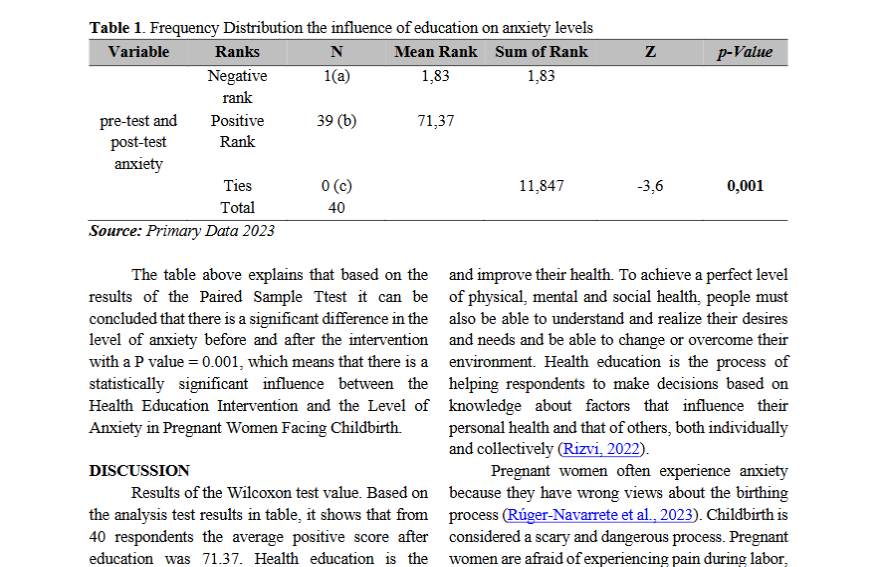
Indonesian women within the 20-to-44-year age bracket are particularly vulnerable to experiencing depression or anxiety in the context of vaginal childbirth, with a reported risk of 10% to 25%. Of this cohort, a notable proportion, specifically 10% to 15%, may experience these psychological difficulties as complications during the delivery process, and the risk of anxiety in caesarean section patients is 15-25%. This was pre-experimental research with a One-Group Pretest and Posttest design. The sample was 40 respondents taken by a Non-Random Sampling technique; Accidental Sampling. This research was conducted October 15 - November 10 2023. The instrument used a questionnaire sheet. A Wilcoxon test was employed for data analysis, demonstrating a significant decrease in anxiety levels after an educational intervention. The mean anxiety score decreased from 2.74 before education to 1.83 afterward, yielding a p-value of 0.001 (which is less than the significance level of 0.05). These results underscore the importance of healthcare providers delivering more comprehensive education on anxiety management to pregnant women facing childbirth, with the aim of alleviating pre-delivery fear and apprehension.
Author Biographies
Evita Widyawati, STIKES Hutama Abdi Husada Tulungagung

Evita Widyawati STIKES Hutama Abdi Husada Tulungagung , Indonesia
Expertise: Midwifery
( Google Scholar,
  Sinta)
Friska Oktaviana, STIKes Hutama Abdi Husada Tulungagung

Friska OktavianaSTIKes Hutama Abdi Husada Tulungagung , Indonesia
Expertise: Midwifery
(Google Scholar, Sinta,  ORCID)
Sundari, Universitas Muhammadiyah Madiun

SundariUniversitas Muhammadiyah Madiun - Indonesia
Expertise: Midwifery and Health Professions
(Google Scholar)
References
Alizadeh-Dibazari, Z., Abdolalipour, S., & Mirghafourvand, M. (2023). The effect of prenatal education on fear of childbirth, pain intensity during labour and childbirth experience: A scoping review using systematic approach and meta-analysis. BMC Pregnancy and Childbirth, 23(1), 1–26. https://doi.org/10.1186/s12884-023-05867-0
Alza, N., & Ismarwati, I. (2018). Faktor-faktor yang mempengaruhi kecemasan ibu hamil trimester III. Jurnal Kebidanan Dan Keperawatan Aisyiyah, 13(1), 1–6. https://doi.org/10.31101/jkk.205
Antos, Z., Zackiewicz, K., Tomaszek, N., Modzelewski, S., & Waszkiewicz, N. (2024). Beyond pharmacology: A narrative review of alternative therapies for anxiety disorders. Diseases, 12(9), 1–44. https://doi.org/10.3390/diseases12090216
Chong, S. C. S., Anderson, K., Mackenzie-Stewart, R., Hobbs, C., & Conna, B. (2022). Embedding experiential learning in undergraduate health promotion curriculum. Health Promotion Journal of Australia, 33(S1), 9–16. https://doi.org/10.1002/hpja.629
Dewi, R., Noviyanti, N., & Idiana, A. (2022). Kecemasan ibu hamil trimester III menghadapi proses persalinan dan melahirkan. Holistik Jurnal Kesehatan, 16(2), 157–163. https://doi.org/10.33024/hjk.v16i2.6314
Diezi, A. S., Vanetti, M., Robert, M., Schaad, B., Baud, D., & Horsch, A. (2023). Informing about childbirth without increasing anxiety: A qualitative study of first-time pregnant women and partners’ perceptions and needs. BMC Pregnancy and Childbirth, 23(1), 1–16. https://doi.org/10.1186/s12884-023-06105-3
Hahn, R. A., & Truman, B. I. (2015). Education improves public health and promotes health equity. International Journal of Health Services, 45(4), 657–678. https://doi.org/10.1177/0020731415585986
Hasim, R. P. (2018). Gambaran kecemasan ibu hamil [Universitas Muhammadiyah Surakarta]. http://eprints.ums.ac.id/63124/1/NASKAH PUBLIKASI ILMIAH.pdf
Hordern, J., Muller, J., & Deng, Z. (2021). Towards powerful educational knowledge? Addressing the challenges facing educational foundations, curriculum theory and Didaktik. Journal of Curriculum Studies, 53(2), 143–152. https://doi.org/10.1080/00220272.2021.1891575
Masita, Erlin Puspita, Yunita Laila Astuti, & Nurmiaty. (2023). The role of midwives in the education of labor and childbirth readiness. Journal of Nursing Practice, 7(1), 107–113. https://doi.org/10.30994/jnp.v7i1.431
Matsas, A., Panopoulou, P., Antoniou, N., Bargiota, A., Gryparis, A., Vrachnis, N., Mastorakos, G., Kalantaridou, S. N., Panoskaltsis, T., Vlahos, N. F., & Valsamakis, G. (2023). Chronic stress in pregnancy is associated with low birth weight: A meta-analysis. Journal of Clinical Medicine, 12(24), 1–10. https://doi.org/10.3390/jcm12247686
Murdayah, Lilis, D. N., & Lovita, E. (2021). Faktor-Faktor Yang Berhubungan Dengan Kecemasan Pada Ibu Bersalin. Jambura Journal of Health Sciences and Research, 3(1), 115–125. https://doi.org/10.35971/jjhsr.v3i1.8467
Nursalam. (2016). Metodologi penelitian ilmu keperawatan: Pendekatan praktis (4th ed.). Salemba Medika.
Przybyła-Basista, H., Kwiecińska, E., & Ilska, M. (2020). Body acceptance by pregnant women and their attitudes toward pregnancy and maternity as predictors of prenatal depression. International Journal of Environmental Research and Public Health, 17(24), 1–12. https://doi.org/10.3390/ijerph17249436
Rizvi, D. S. (2022). Health education and global health: Practices, applications, and future research. Journal of Education and Health Promotion, 11(262), 1–6. https://doi.org/10.4103/jehp.jehp
Rúger-Navarrete, A., Vázquez-Lara, J. M., Antúnez-Calvente, I., Rodríguez-Díaz, L., Riesco-González, F. J., Palomo-Gómez, R., Gómez-Salgado, J., & Fernández-Carrasco, F. J. (2023). Antenatal fear of childbirth as a risk factor for a bad childbirth experience. Healthcare (Switzerland), 11(3), 1–13. https://doi.org/10.3390/healthcare11030297
Sari, I. D., & Pakpahan, S. (2021). Pengaruh Video Persalinan Normal terhadap Kecemasan Ibu Hamil Menghadapi Persalinan di Wilayah Kerja Puskesmas Pangaribuan Kecamatan Pangaribuan Kabupaten Tapanuli Utara. Jurnal Ilmiah Universitas Batanghari Jambi, 21(3), 1357. https://doi.org/10.33087/jiubj.v21i3.1559
Schetter, C. D., Rahal, D., Ponting, C., Julian, M., Ramos, I., Hobel, C. J., & Coussons-Read, M. (2022). Anxiety in pregnancy and length of gestation: Findings from the healthy babies before birth study. Health Psychology, 41(12), 894–903. https://doi.org/10.1037/hea0001210
Stoye, D. Q., Blesa, M., Sullivan, G., Galdi, P., Lamb, G. J., Black, G. S., Quigley, A. J., Thrippleton, M. J., Bastin, M. E., Reynolds, R. M., & Boardman, J. P. (2020). Maternal cortisol is associated with neonatal amygdala microstructure and connectivity in a sexually dimorphic manner. ELife, 9(e60729), 1–18. https://doi.org/10.7554/eLife.60729
Susanti, Hassan, H. C., & Aljaberi, M. A. (2024). Pregnancy exercise effectiveness on anxiety level among pregnant women. Journal of Public Health Research, 13(2), 1–5. https://doi.org/10.1177/22799036241246701
Suyani, S. (2020). Hubungan Tingkat Pendidikan Dan Status Pekerjaan Dengan Kecemasan Pada Ibu Hamil Trimester Iii. JKM (Jurnal Kesehatan Masyarakat) Cendekia Utama, 8(1), 19. https://doi.org/10.31596/jkm.v8i1.563
WHO. (2017). Depression and other common mental disorders.
WHO. (2024). Maternal mortality.
Wigert, H., Nilsson, C., Dencker, A., Begley, C., Jangsten, E., Sparud-Lundin, C., Mollberg, M., & Patel, H. (2020). Women’s experiences of fear of childbirth: A metasynthesis of qualitative studies. International Journal of Qualitative Studies on Health and Well-Being, 15(1), 1–17. https://doi.org/10.1080/17482631.2019.1704484
Downloads
Published
Issue
Section
License
Copyright (c) 2024 Jurnal Ners dan Kebidanan (Journal of Ners and Midwifery)

This work is licensed under a Creative Commons Attribution-ShareAlike 4.0 International License.