Health and Relaxation Corner: Empowering Food Vendors Around Hospitals Through Innovative Training
DOI:
https://doi.org/10.26699/jcsh.v6i2.1278Keywords:
Community Empowerment, MSMEs, Food Vendors, Health Promotion, Innovative TrainingAbstract
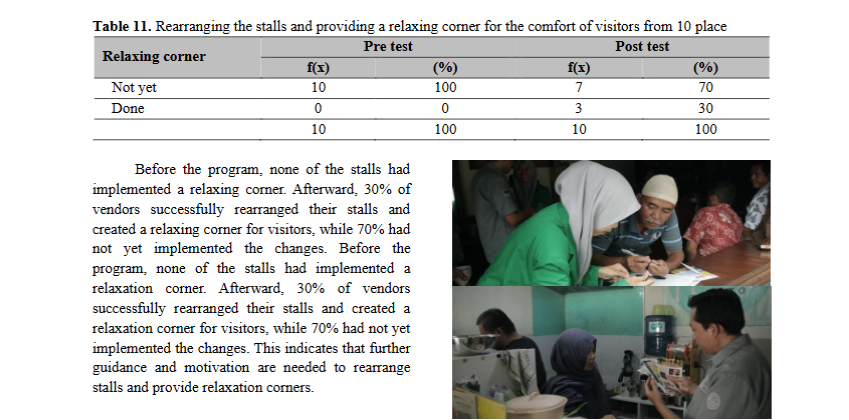
Micro, Small, and Medium Enterprises (MSMEs) in the culinary sector play a vital role in supporting the economy, particularly around hospitals where food demand is consistent. However, many vendors face challenges such as poor hygiene practices, limited menu innovation, inadequate financial literacy, and lack of consumer-friendly facilities, which reduce competitiveness and pose risks to public health. To address these issues, the Healthy & Relaxing Corner community service program was implemented with 20 vendors from 10 stalls around Saiful Anwar Hospital, Malang, through outreach, training, mentoring, provision of simple technologies, and participatory evaluation. The training modules included Clean and Healthy Living Behavior; PHBS (Perilaku Hidup Bersih dan Sehat), food safety, herbal menu diversification, financial management, product photography, digital marketing, waste management, and stall layout improvements. The results demonstrated significant progress: knowledge improved from 65% poor to 90% good, PPE use rose from 25% to 100%, and all participants achieved proper financial recording skills. Additionally, 75% reached good practice in product photography, 50% attained good ability in digital promotion, and 100% adopted correct waste sorting. All stalls successfully introduced herbal drinks, while half modified cooking techniques for healthier food preparation. However, only 30% of vendors created relaxing corners, suggesting that financial and space constraints limited physical restructuring. Overall, the program effectively improved hygiene, entrepreneurship, and innovation, contributing to healthier food environments and more sustainable income for vendors. The model is replicable for MSME empowerment in other communities, with future initiatives recommended to combine training with micro-financing or infrastructure support to maximize outcomes.
Author Biographies
-
Frengki Apryanto, STIKES Widyagama Husada

Frengki Apryanto
 STIKes Widyagama Husada, Malang, Indonesia
Expertise : Nursing
( Google Scholar,
  Sinta,
  ORCID)
 -
Rahmaniah Ramadhani, STIKES Widyagama Husada

Rahmaniah Ramadhani STIKes Widyagama Husada, Malang, Indonesia
Expertise: Health and Management
( Google Scholar,
  Sinta,
  ORCID)
 -
Rudy Joegijantoro, STIKES Widyagama Husada

Rudy Joegijantoro STIKes Widyagama Husada, Malang, Indonesia
Expertise: Medicine, Public Health, Hospital Administration
(Google Scholar,  Scopus, Sinta, ORCID)
References
Archila-Godínez, J. C., Chen, H., Klinestiver, L., Rosa, L., Barrett, T., Henley, S. C., & Feng, Y. (2022). An Evaluation of a Virtual Food Safety Program for Low-Income Families: Applying the Theory of Planned Behavior. Foods (Basel, Switzerland), 11(3). https://doi.org/10.3390/foods11030355
Bangun, K., Simangunsong, E., Prodi, S., Rumah, A., & Sejati, S. M. (2024). Pelatihan Pelaksanaan Peningkatan Kapasitas Sumber Daya Manusia Pariwisata Kabupaten Dairi (SubTopik: Pemasaran, Inovasi dan Higienitas Kuliner). DEVOTIONIS, 2(2), 39–42. https://doi.org/10.54367/devotionis.v2i2.3473
BPOM RI. (2021). Pedoman Higiene dan Sanitasi Pangan bagi Pedagang Makanan (1st ed.). BPOM RI.
Chopra, B., & Seth, D. U. (2021). Knowledge, Education Level and Food Handling Practices among Street Food Vendors: A Systematic Review. International Journal of Scientific and Research Publications (IJSRP), 11(6), 554–565. https://doi.org/10.29322/ijsrp.11.06.2021.p11473
Dhudum, B., & Bhosale, Y. (2025). Street Food Handlers’ Knowledge and Hygiene Practices: A Descriptive Study. Cureus, 17(1), e77894. https://doi.org/10.7759/cureus.77894
Kemenkes RI. (2020). Profil Kesehatan Indonesia Tahun 2020.
Liu, C. (2021). Overview on development of ASEAN traditional and herbal medicines. Chinese Herbal Medicines, 13(4), 441–450. https://doi.org/10.1016/j.chmed.2021.09.002
Lubis, P. S. I., & Salsabila, R. (2024). Peran UMKM (Usaha Mikro, Kecil, Dan Menengah) Dalam Meningkatkan Pembangunan Ekonomi Di Indonesia. MUQADDIMAH: Jurnal Ekonomi, Manajemen, Akuntansi Dan Bisnis, 2(2), 91–110. https://doi.org/10.59246/muqaddimah.v2i2.716
Madjdian, D. S., Dankwah Badu, V., Ilboudo, G., Lallogo, V. R., Dione, M., van Asseldonk, M., Knight-Jones, T. J. D., & de Vet, E. (2024). Fast food over safe food? A qualitative evaluation of a food safety training intervention for street vendors applying the COM-B model in Ouagadougou, Burkina Faso. PloS One, 19(11), e0313635. https://doi.org/10.1371/journal.pone.0313635
Mahopo, T. C., Nesamvuni, C. N., Nesamvuni, A. E., de Bryun, M., van Niekerk, J., & Ambikapathi, R. (2022). Operational Characteristics of Women Street Food Vendors in Rural South Africa. Frontiers in Public Health, 10(July), 1–11. https://doi.org/10.3389/fpubh.2022.849059
Moges, M., Rodland, E. K., & Argaw, A. (2024). Sanitary condition and hygienic practice of street food vendors in selected towns of Ethiopia: A cross-sectional study addressing public health concern. Journal of Agriculture and Food Research, 15, 100857. https://doi.org/10.1016/j.jafr.2023.100857
Ningsih, S., Dewi Pamungkasari, P., Hindarto, D., Diana Sholihati, I., Tri Esti Handayani, E., & Titi Komala Sari, R. (2025). Pemanfaatan Social Media Marketing Untuk Para Pelaku Bisnis Umkm. Communnity Development Journal, 6(3), 5102–5107. https://doi.org/10.31004/cdj.v6i4.47652
Nurmala, N., Sinari, T., Lilianti, E., Jusmany, J., Emilda, E., & Arifin, A. (2022). Culinary Business as a Driver for MSMEs During the Covid-19 Pandemic. AKM: Aksi Kepada Masyarakat, 3(1), 65–74. https://doi.org/10.36908
Rakha, A., Fatima, M., Bano, Y., Khan, M. A., Chaudhary, N., & Aadil, R. M. (2022). Safety and quality perspective of street vended foods in developing countries. Food Control, 138, 109001. https://doi.org/10.1016/j.foodcont.2022.109001
Riani, J., Ilham, M., Igo BD, A., & Yamin, L. O. M. (2023). Analisis Pendapatan Usaha Mikro Dan Kecil Pada Objek Wisata Napabale Di Desa Lohia Kecamatan Lohia Kabupaten Muna. Jurnal Online Program Studi Pendidikan Ekonomi, 8(3), 388–403.
Sepadi, M. M., & Nkosi, V. (2023). Health Risk Assessment of Informal Food Vendors: A Comparative Study in Johannesburg, South Africa. International Journal of Environmental Research and Public Health, 20(3), 1–15. https://doi.org/10.3390/ijerph20032736
Sri, A., & Kusrini, Wu. (2023). Intervensi Higiene Dan Sanitasi Lingkungan Dengan Memberdayakan Pedagang Kaki Lima Untuk Mewujudkan Keamanan Pangan Yang Higienis Di Kelurahan Gunung, Kebayoran Baru, Jakarta Selatan Tahun 2022. AMMA : Jurnal Pengabdian Masyarakat, 2(1), 1–12. https://www.journal.mediapublikasi.id/index.php/amma/article/view/2045
Sunarso, B., Tusriyanto, & Mustafa, F. (2023). Analysing the Role of Visual Content in Increasing Attraction and Conversion in MSME Digital Marketing. Journal of Contemporary Administration and Management (ADMAN), 1(3), 193–200. https://doi.org/10.61100/adman.v1i3.79
WHO. (2024). Food Safety. Who.Int. https://www.who.int/news-room/fact-sheets/detail/food-safety
Ye, J., & Kulathunga, K. M. M. C. B. (2019). How does financial literacy promote sustainability in SMEs? A developing country perspective. Sustainability, 11(10), 1–21. https://doi.org/10.3390/su11102990
Yogatama, A. N., Sidi, A. P., Anjaningrum, W. D., Bukhori, M., Dura, J., Cahyaningtyas, F., Andriany, L. M., & Hanif, R. (2025). Digital Transformation in Street Food Business in Malang: AI Application Training for Content Creation and Effective Promotion Strategies. Jurnal Pengabdian Masyarakat, 6(1), 111–121. https://doi.org/10.32815/jpm.v6i1.2299
Yusof, N. S., & Ramli, K. I. (2025). Evaluating Local Street Food Service Quality: Insights from Visitors to Penang. International Journal of Academic Research in Business and Social Sciences, 15(1), 1447–1463. https://doi.org/10.6007/ijarbss/v15-i1/24520