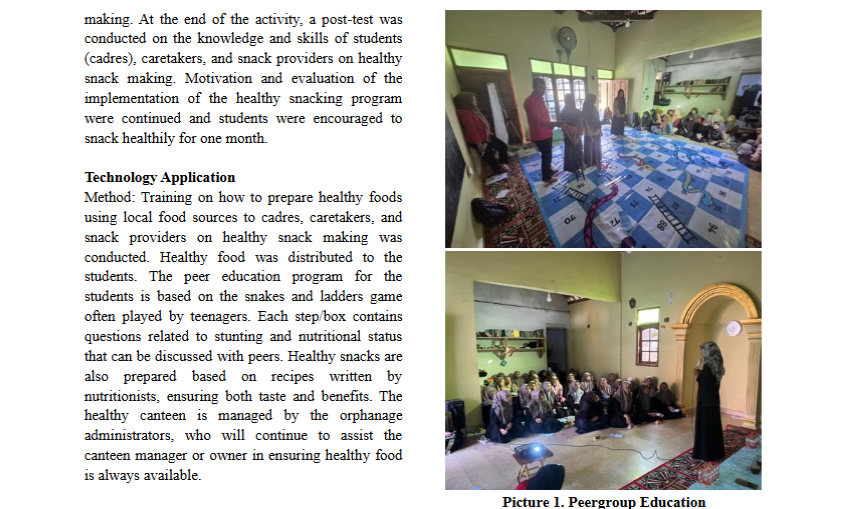
Peer Group Education and Healthy Snacking for Adolescent Girls (Prospective Mothers) in Islamic Boarding Schools as an Effort to Reduce the Number of Stunting Cases
DOI:
https://doi.org/10.26699/jcsh.v6i2.1261Keywords:
Adolescent Girls, Stunting, Peergroup Education, Healthy Snacking, NutritionAbstract
Young women, as prospective mothers, needed to prepare themselves to give birth to a quality generation. Preventing stunting in adolescents involved increasing knowledge and awareness of the use of local foods. The partner in this community service program was the Madrosatul Qur'an Hidayatul Mubtadiin Islamic Boarding School. The goal of this community service program for beginners was to increase the knowledge and awareness of young women (prospective mothers) at the Islamic boarding school regarding the importance of balanced nutrition for stunting prevention from adolescence, encourage healthy snacking habits based on local foods, increase access to nutritious food to support healthy nutrition for adolescents as a stunting prevention effort, and develop adolescent health cadres capable of becoming agents of change within the Islamic boarding school and the surrounding community. The results of data analysis using the Wilcoxon signed rank test obtained P = 0.000, so it was concluded that the provision of peer group education could increase the knowledge and awareness of young women (prospective mothers) regarding the importance of balanced nutrition for preventing stunting since adolescence and that was achieved was that the students exhibited very good healthy snacking behavior (88%) and fairly good healthy snacking behavior (12%). This service encouraged healthy snacking habits to fulfil balanced nutrition for students, increased access to nutritious food to support nutritional fulfillment as an effort to prevent stunting by modifying a healthy canteen, and built health cadres of adolescent cadres who were able to become agents of change in the community.
Author Biographies
-
Wimar Anugrah Romadhon, STIKes Patria Husada Blitar

Wimar Anugrah Romadhon STIKes Patria Husada Blitar, Indonesia
Expertise: Community Health Nursing, Geriatric Nursing, Family Nursing
( Google Scholar,
  Sinta,
  ORCID)
 -
Ning Arti Wulandari, STIKes Patria Husada Blitar, Indonesia

Ning Arti Wulandari
 STIKes Patria Husada Blitar, East Java, Indonesia
Expertise: Nursing and Health Profession
( Google Scholar,
  Sinta,
  ORCID)
 -
Nur Aini Mahmudah, AKN Putra Sang Fajar

Nur Aini Mahmudah
AKN Putra Sang Fajar, East Java, Indonesia
Expertise: Functional Food, Food Chemistry, Food Processing
(Google Scholar, Sinta, ORCID)
References
Aini, N., Agustin, N., Wirawantoro, A., & Purnomo, P. (2024). Preventing stunting among adolescents by increasing knowledge and awareness of local food utilization. 5(3), 624–630. https://doi.org/10.22219/jcse.v5i3.34583
Aktyani Putri, R. R. D. R., & Romadhon, W. A. (2024). Sunrise Model “Transcultural Nursing Leininger” on Toddler Stunting Incidents. Jurnal Ners Dan Kebidanan, 6(3), 263–275. https://doi.org/10.26699/jnk.v11i3.ART.p263-275
Asatuti, N. B., Sumardi, R. N., Ngardita, I. R., & Lusiana, S. A. (2021). Pemantauan Status Gizi Dan Edukasi Gizi pada Remaja Sebagai Upaya Pencegahan Stunting. Asmat Jurnal Pengabmas, 1(1), 46–56. https://doi.org/10.47539/ajp.v1i1.8
Beal, T., Tumilowicz, A., Sutrisna, A., Izwardy, D., & Neufeld, L. M. (2018). A review of child stunting determinants in Indonesia. Maternal and Child Nutrition, 14(4), 1–10. https://doi.org/10.1111/mcn.12617
BPS. (2018). Dalam Angka SKI. In Kota Kediri Dalam Angka.
Dewey, K. G. (2016). Reducing stunting by improving maternal, infant and young child nutrition in regions such as South Asia: Evidence, challenges and opportunities. Maternal and Child Nutrition, 12, 27–38. https://doi.org/10.1111/mcn.12282
Fauzi, C. A. (2012). Analisis Pengetahuan Dan Perilaku Gizi Seimbang Menurut Pesan Ke-6, 10, 11, 12 Dari Pedoman Umum Gizi Seimbang (Pugs) Pada Remaja. Indonesian Journal of Reproductive Health, 3(2), 91–105.
Ika Indriyastuti, H., Tri Kartono, D., & Studi Sosiologi Fakultas iLmu Sosial Dan Politik, P. (2022). Implementation of the Sustainable Development Goals (SDGs) Program on the Management of Stunting Cases in Indonesia. International Journal of Recent Research in Interdisciplinary Sciences (IJRRIS), 9(2),
–65. https://doi.org/10.5281/zenodo.6631152
Indtiyastuti, I. H., & Kartono, T. D. (2022). Implementation of the Sustainable Development Goals (SDGs) Program on the Management of Stunting Cases in Indonesia. International Journal of Recent Research in Interdisciplinary Sciences (IJRRIS), 9(2), 60–65. https://doi.org/10.5281/zenodo.6631152
Lubis, M. S., Simamora, A. A., & Batubara, R. A. (2022). The effect of health education through peer group education on increasing adolescent knowledge about stunting. Science Midwifery, 12(3), 1–8.
Lusiana, S. A., Gizi, J., & Kemenkes, P. (2021). Pemantauan Status Gizi Dan Edukasi Gizi Pada Remaja Sebagai. 01(01), 46–56. https://doi.org/10.47539/ajp.v1i1.8
Tarini, N. W. D., Sugandini, W., & Sulyastini, N. K. (2020). Prevalence of Anemia and Stunting in Early Adolescent Girls. 394(Icirad 2019), 397–402. https://doi.org/10.2991/assehr.k.200115.065
Vir, S. C. (2016). Improving women’s nutrition imperative for rapid reduction of childhood stunting in South Asia: Coupling of nutrition specific interventions with nutrition sensitive measures essential. Maternal and Child Nutrition, 12, 72–90. https://doi.org/10.1111/mcn.12255
Zufriady, Z., Marconi, A. P., Adam, B. I. F., Zikri, K., Darmaneva, N. R., Azizah, N. R., Limbong, P., Febrianti, R. O., Fadila, S., Sahbani, V., & Juwita, Z. (2022). Pengabdian Pengabdian Masyarakat Melalui Sosialisasi Pencegahan Stunting Di Desa Lubuk Agung. Jurnal Pengabdian Multidisiplin, 3(1), 1–5. https://doi.org/10.51214/japamul.v3i1.365